
Hunting Optics / Binocular Comparison
8x42 vs 10x42 Binoculars: Which Is Better for Hunting?
Balance image detail, field of view, and handheld stability for the terrain you hunt most often.
A flicker of movement in thick timber. A buck stepping along a distant field edge. An elk tucked into a shaded hillside. Each situation asks something different from your binoculars—and more magnification isn’t always the biggest advantage.
When comparing 8x42 vs 10x42 binoculars for hunting, the choice comes down to how you balance detail, field of view, and a steady image.
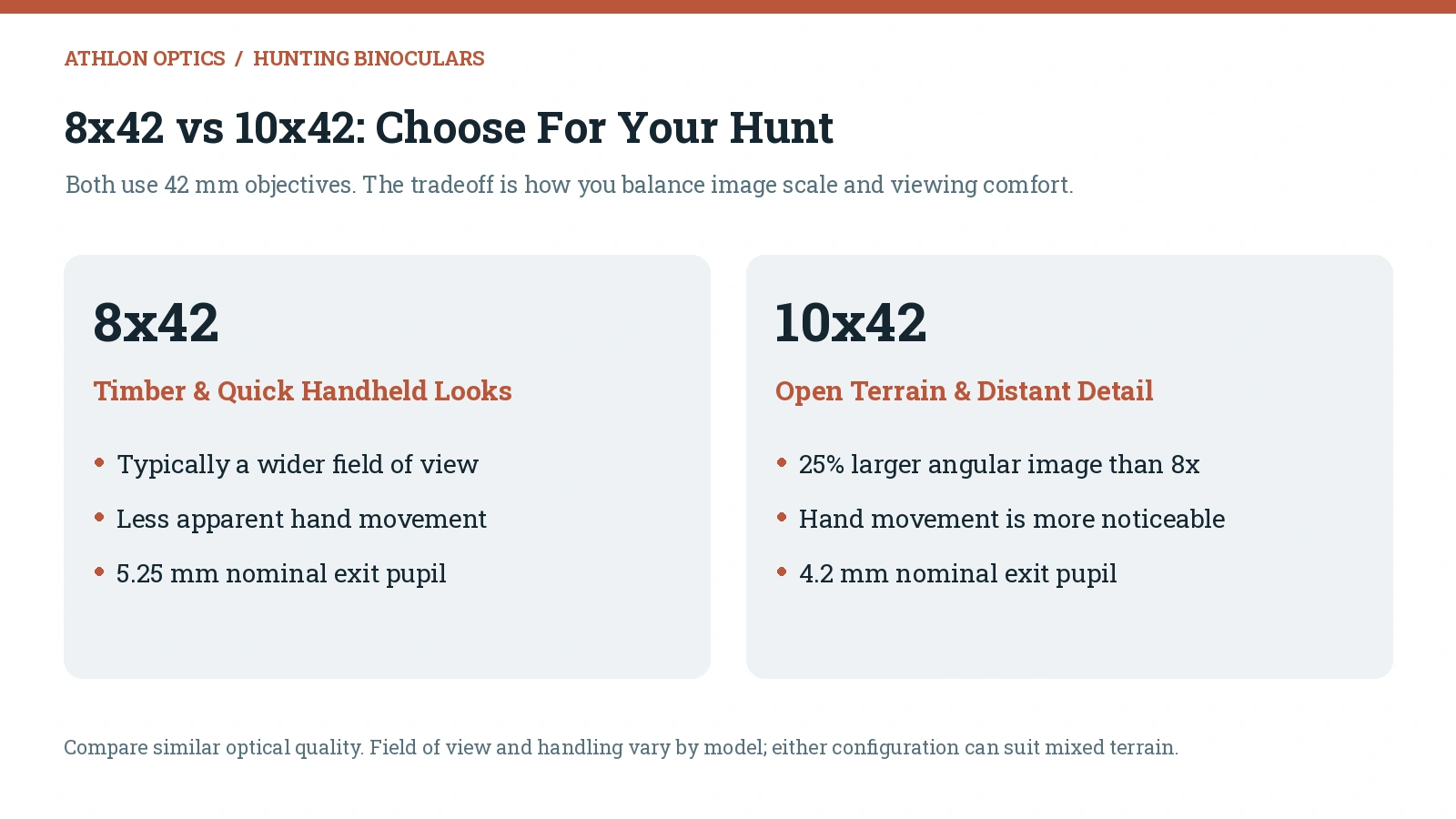
For hunters who spend most of their time in timber or treestands, 8x42 binoculars are often the better fit. For hunters glassing open fields and distant terrain, 10x42 binoculars provide additional magnification that can help reveal details. Both configurations are versatile enough for a wide range of hunts.
Here’s how to choose the right pair for the way you hunt.
8x42 vs 10x42 Binoculars: Quick Comparison
The differences below generally apply when comparing binoculars of similar optical quality and design. Check individual specifications, especially field of view, eye relief, and weight.
View the full comparison as text
| Feature | 8x42 Binoculars | 10x42 Binoculars |
|---|---|---|
| Magnification | 8 times | 10 times |
| Objective lens diameter | 42 mm | 42 mm |
| Field of view | Typically wider | Typically narrower |
| Handheld image | Usually easier to hold steady | Makes hand movement more noticeable |
| Exit pupil | 5.25 mm | 4.2 mm |
| Main advantage | Scanning terrain and following movement | Examining details at greater distances |
| Common hunting applications | Timber, treestands, still-hunting | Open fields, western terrain, distant glassing |
Neither configuration wins every category. The best binocular magnification for hunting depends on where you spend the most time and how you use your optics.
What Do 8x42 and 10x42 Mean?
The first number describes magnification. An 8x binocular makes a subject appear eight times larger in angular size than it does with the unaided eye. A 10x binocular provides ten times magnification.
That means a 10x binocular makes the same subject appear 25% larger in angular dimensions than an 8x binocular. This describes image scale, not a guaranteed 25% increase in resolved detail; optical quality, conditions, and stability still matter.
The second number is the diameter of the objective lenses in millimeters. Both configurations use 42 mm objectives—the large lenses at the front of the binocular.
Because the objective diameter is the same, the main differences come from magnification and the optical design surrounding it.
For a broader explanation of binocular features, read our Binoculars 101 guide.
Field of View: Finding Movement in Timber and Cover
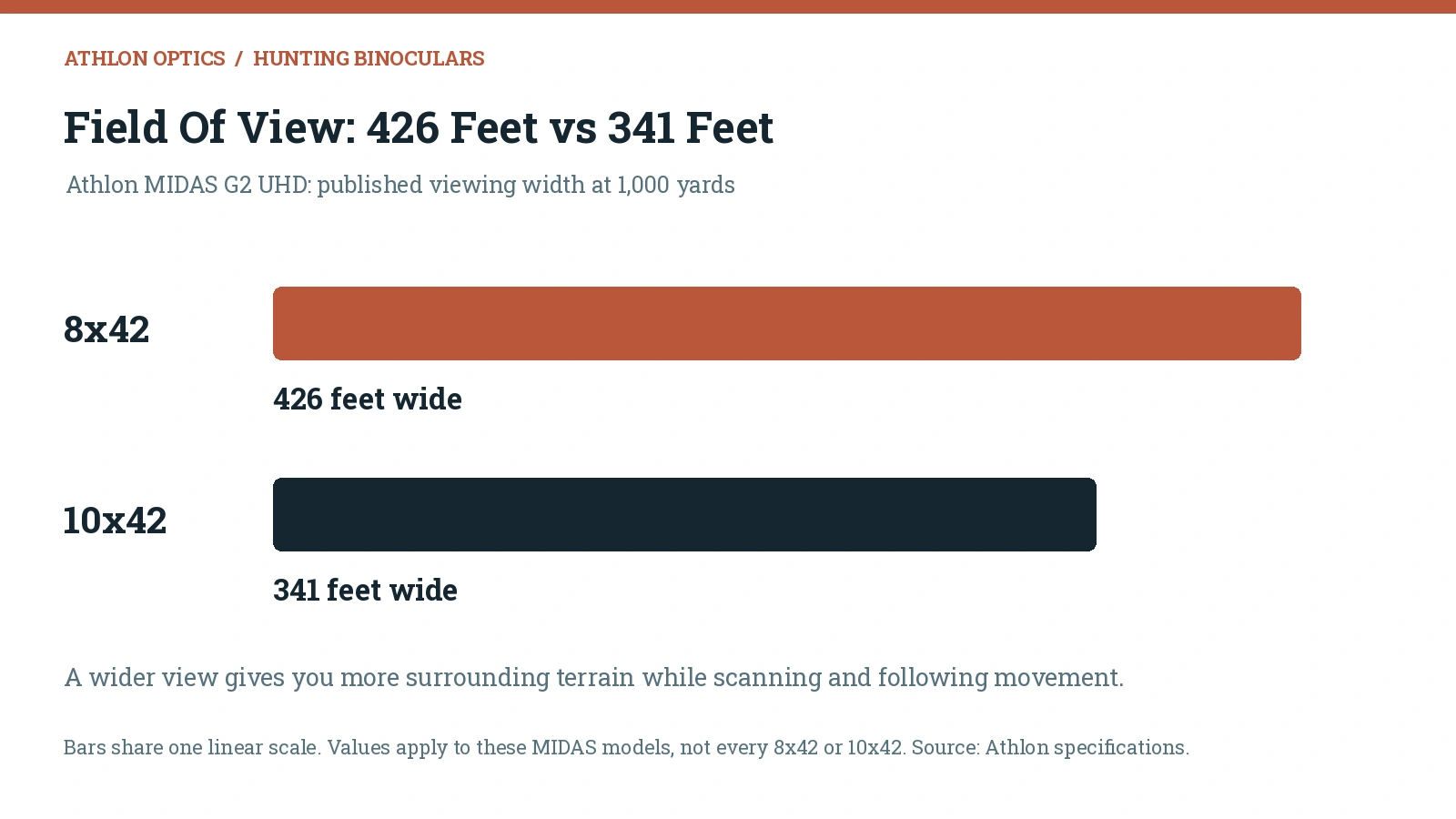
Field of view describes how much of the scene you can see through your binoculars. It is commonly listed as a width in feet at 1,000 yards.
A wider field of view helps you scan more terrain at once. It can also make it easier to locate an animal after raising your binoculars and follow it as it moves.
Imagine watching a wooded creek bottom from a treestand. A deer slips between two trees, then disappears behind brush. A wider view gives you more surrounding context as you search for the next opening.
That’s one reason 8x42 binoculars are a strong choice for whitetail hunting in timber. You can examine cover while keeping more of the scene visible.
Within comparable product lines, a 10x42 binocular generally trades some viewing width for a larger image of the subject. Field of view is also a design choice, so check the actual specification rather than assuming every 8x model has a wider view than every 10x model. That trade can be useful when you have already located an animal and want a closer look.
Are 8x42 or 10x42 Binoculars Better for Deer Hunting?
Start with your typical view from the stand.
For Timber, Treestands, and Thick Cover
An 8x42 binocular is often an excellent match for wooded whitetail country.
The combination of a wider field of view and less apparent image shake helps when you’re scanning brush, checking trails, or following deer through small openings.
Eight-power magnification also works well for quick handheld looks. That matters when you’re seated against a tree, wearing bulky clothing, or trying to minimize movement.
For Food Plots, Agricultural Fields, and Open Country
A 10x42 binocular becomes more appealing when you regularly watch larger openings.
The additional magnification can help you examine a deer across a field or study movement along a distant edge. You’ll see a larger image of the subject, provided you can hold the binocular steady enough to use that extra detail.
If your hunting includes both thick woods and large fields, consider which situation accounts for most of your glassing. Either configuration can handle mixed terrain, but your most common view should guide the purchase.
Are 10x42 Binoculars Better for Western Hunting?
Ten-power binoculars are a versatile option for western hunting because open terrain often creates opportunities to glass farther.
When you’re searching distant slopes, looking into shaded pockets, or examining animals across a drainage, the larger image can be useful.
However, 8x42 binoculars still have a place in western country. Their wider view can help when scanning broad areas, and the steadier handheld image can be welcome when you’re glassing after a climb.
Think about how you hunt:
- Frequent hiking and short handheld glassing sessions: 8x42 can be comfortable and easy to manage.
- Regularly examining distant animals: 10x42 provides additional image scale.
- Long glassing sessions from one position: A tripod or other stable support can improve the usefulness of either configuration.
Magnification is only part of the equation. Optical clarity, comfort, and stability all affect how much you actually see.
8x42 vs 10x42 in Low Light
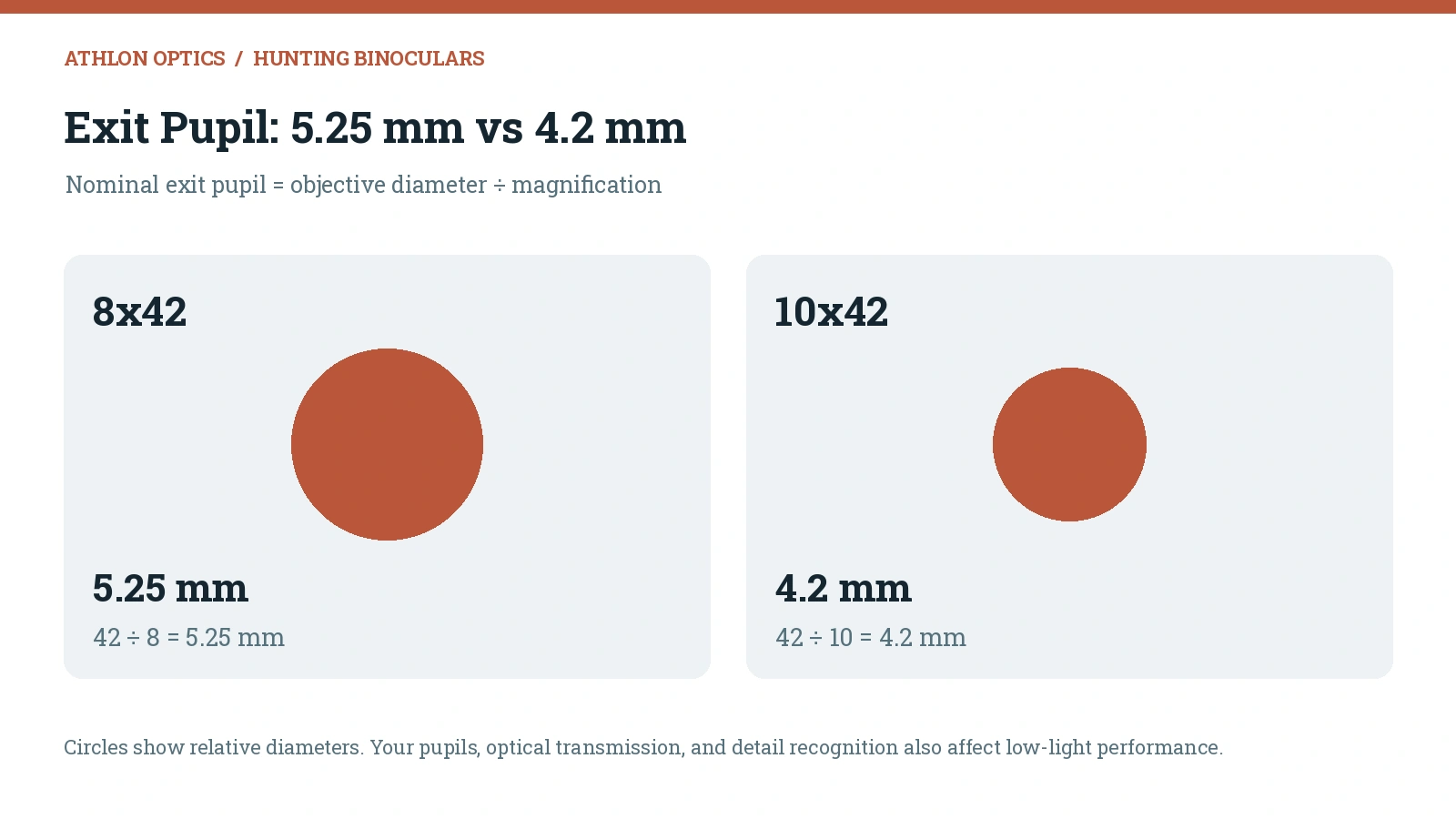
Both binocular configurations use 42 mm objective lenses, but they produce different exit pupil sizes.
The exit pupil is the small circle of light visible in each eyepiece when you hold the binocular away from your face. Calculate it by dividing objective lens diameter by magnification:
- 8x42: 42 ÷ 8 = 5.25 mm
- 10x42: 42 ÷ 10 = 4.2 mm
The larger exit pupil of an 8x42 binocular can help maintain a bright view in dim conditions when your pupils are sufficiently dilated. It can also make eye placement more forgiving.
A larger exit pupil will not automatically improve the view if your eye’s pupil is already the smaller opening.
Exit pupil alone does not determine low-light performance. Glass quality, lens coatings, optical transmission, and your own eyesight also matter. The additional magnification of a 10x binocular may help you distinguish details even when its exit pupil is smaller.
Compare binoculars of similar quality, and try both configurations in shaded or fading light when possible. Pay attention to how easily you can identify detail and maintain a comfortable view.
Are 10x Binoculars Hard to Hold Steady?
Many hunters use 10x binoculars comfortably without a tripod. However, greater magnification also magnifies the movement of your hands.
Wind, fatigue, heavy breathing, and an awkward position can make that movement more noticeable. If the image is constantly moving, extra magnification may provide less benefit than you expect.
To improve stability, tuck your elbows toward your body, glass from a seated position, or brace your arms on a solid rest. For extended sessions, use a compatible tripod adapter and tripod.
If most of your viewing happens quickly and without support, the steadier apparent image of an 8x42 binocular may be more useful to you.
Compare Athlon MIDAS G2 UHD 8x42 and 10x42 Binoculars
Comparing two models from the same product family helps show the practical tradeoffs. These are Athlon’s published specifications for the named models; other binoculars can differ.
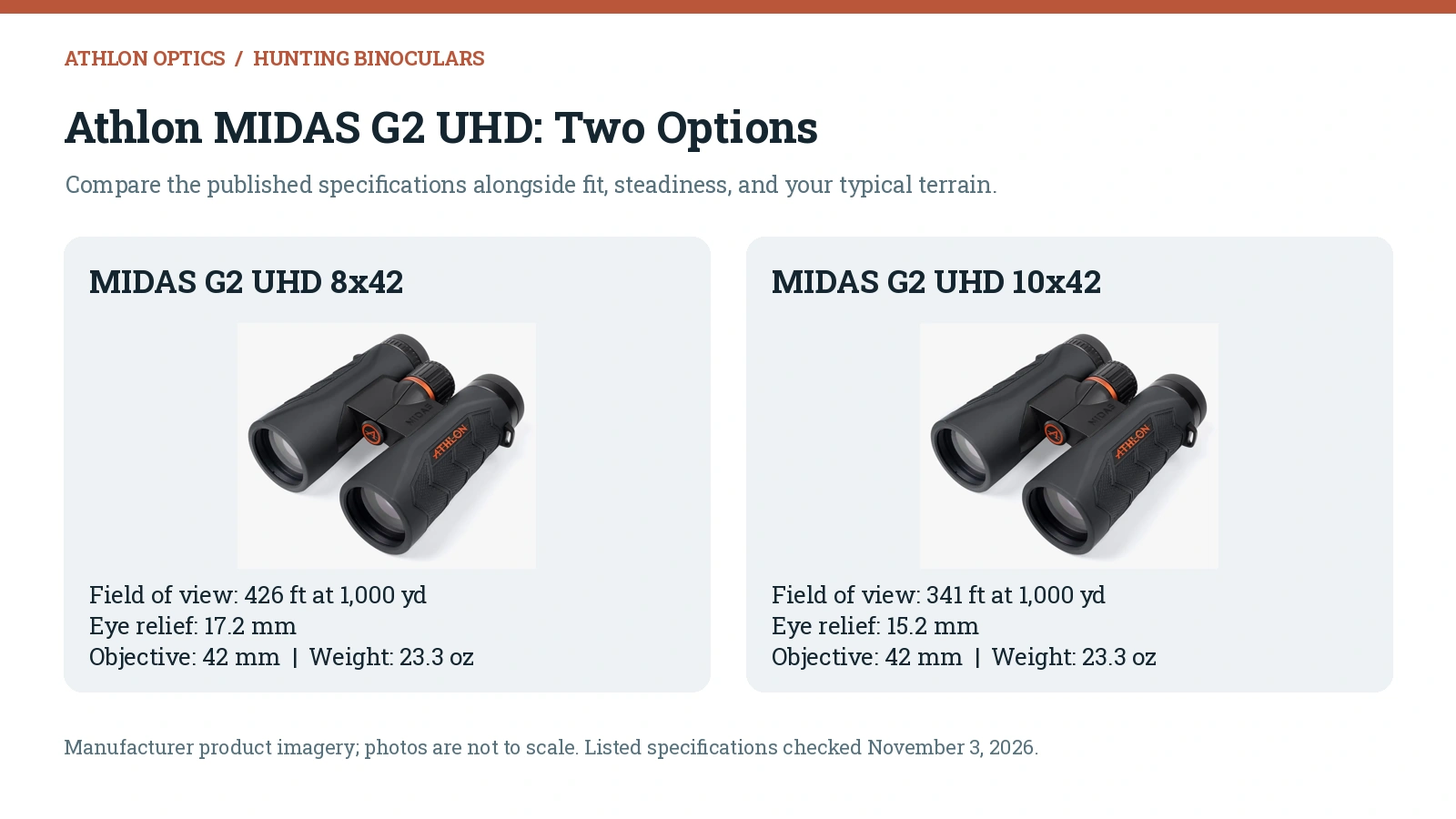
View the full comparison as text
| Specification | MIDAS G2 UHD 8x42 | MIDAS G2 UHD 10x42 |
|---|---|---|
| Magnification | 8x | 10x |
| Objective lens diameter | 42 mm | 42 mm |
| Field of view at 1,000 yards | 426 ft | 341 ft |
| Eye relief | 17.2 mm | 15.2 mm |
| Weight | 23.3 oz | 23.3 oz |
The MIDAS G2 UHD 8x42 offers a wider field of view and longer listed eye relief. It’s a compelling option for hunters who prioritize scanning cover, handheld comfort, and keeping moving animals in view.
The MIDAS G2 UHD 10x42 provides additional magnification at the same listed weight. It suits hunters who want a closer view across fields, hillsides, and other open terrain.
If you wear glasses, compare eye relief and eyecup fit carefully. Your ability to see the full field comfortably matters as much as the specifications on paper.
Which Binocular Magnification Should You Choose?
Choose 8x42 binoculars if you:
- Spend most of your time hunting timber or thick cover.
- Value a wider field of view.
- Want an image that is easier to hold steady.
- Frequently take quick handheld looks from a treestand or while hiking.
Choose 10x42 binoculars if you:
- Regularly glass open fields or distant terrain.
- Want animals to appear larger in the view.
- Can brace your binoculars or use support when needed.
- Prefer extra magnification in a versatile hunting binocular.
Choose around the terrain you hunt most often. A binocular that feels comfortable and helps you find animals consistently will earn its place in your pack.
Explore the Athlon MIDAS G2 UHD binocular lineup to compare configurations for your next hunt.
Frequently Asked Questions
Is 8x42 or 10x42 Better for Whitetail Hunting?
An 8x42 binocular is often a better fit for timber and treestand hunting because it typically provides a wider field of view and less apparent image shake. A 10x42 binocular can be useful when watching larger fields or examining deer farther away.
Can You Use 10x42 Binoculars Without a Tripod?
Yes. Many hunters use 10x42 binoculars handheld. Bracing your arms helps steady the image, while a tripod can improve comfort and detail recognition during extended glassing sessions.
Do 8x42 Binoculars Gather More Light Than 10x42 Binoculars?
Both configurations have the same objective lens diameter. An 8x42 binocular produces a larger exit pupil, which can help in dim conditions depending on your eyes. Overall image brightness also depends on the binocular’s optical quality and transmission.
Are 10x42 Binoculars Heavier Than 8x42?
Not necessarily. Weight depends on the model and construction. Athlon lists both the MIDAS G2 UHD 8x42 and 10x42 at 23.3 ounces.
Can 8x42 Binoculars Work for Elk Hunting?
Yes. An 8x42 binocular can work well for elk hunting, particularly when you value a wide view and steady handheld glassing. Hunters who frequently examine animals across open terrain may prefer 10x42 for its additional magnification.
Compare the MIDAS G2 UHD configurations for your terrain, viewing habits, and fit.