
Deer Hunting / Riflescope Selection
Scope Magnification for Deer Hunting: How Much Do You Need?
Compare magnification ranges for timber, fields, and open country—and learn why your lowest setting matters.
The right scope magnification for deer hunting gives you enough detail to aim precisely while keeping enough of the scene in view to find the deer easily. A 3-9x remains a useful starting point for many whitetail hunters. Lower minimum power can help in thick cover, while a range such as 3-15x can add flexibility in open terrain.
Begin with the closest likely encounter, the terrain you hunt most often, and the distances at which you have demonstrated consistent accuracy from field positions. The highest number on the scope does not determine your effective hunting range.
Here is how to compare magnification ranges, field of view, low-light performance, and reticle designs for your deer rifle.
The Short Answer: Match the Scope to the Terrain
These are practical examples to compare, rather than requirements or guarantees of shooting distance:
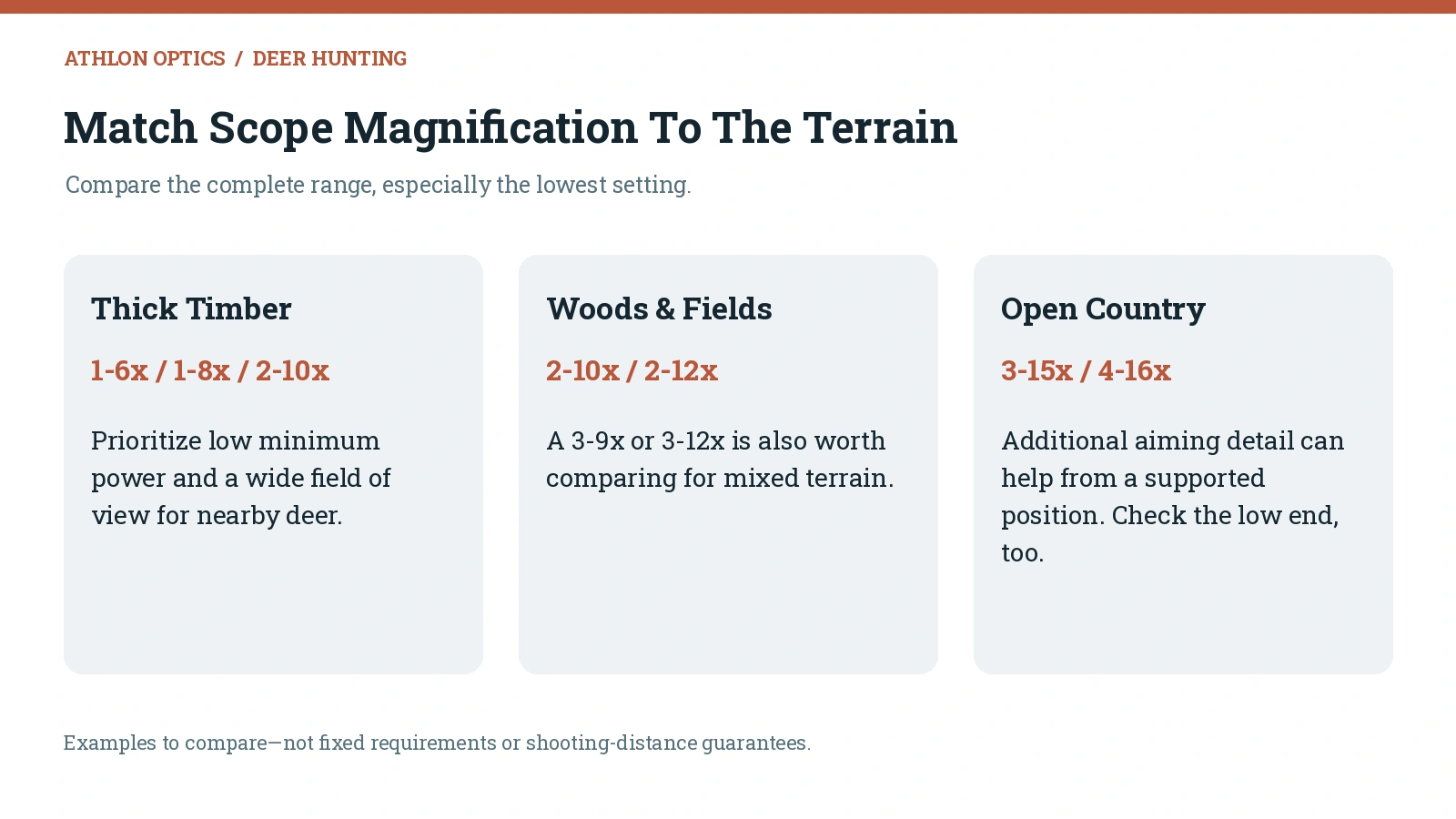
View the comparison as text
| Hunting Conditions | Example Magnification Ranges | Main Priority |
|---|---|---|
| Thick timber and close cover | 1-6x, 1-8x, 2-10x | Low minimum power and a wide field of view |
| Mixed woods and fields | 2-10x, 2-12x, 3-9x, 3-12x | Flexibility for nearby and more distant opportunities |
| Open fields and western terrain | 3-15x, 4-16x | Additional aiming detail from a supported position |
There is considerable overlap. A 3-9x can serve in woods and fields, and a 2-12x can suit a hunter who wants a low minimum with more top-end power. Compare the actual scope's viewing comfort, weight, and reticle before choosing.
Keep a variable scope toward the low end when a close encounter is possible. Increase power only when the situation gives you time and the larger image helps.
What Do Scope Magnification Numbers Mean?
A 3-9x40 scope has an adjustable magnification range from 3x to 9x and a 40-millimeter objective lens. The first two numbers describe magnification; the last describes the diameter of the front lens.
At 3x, an object appears roughly three times its unaided angular size. At 9x, it appears roughly nine times its unaided angular size. You adjust the power ring to choose a setting within that range.
Objective diameter is separate from magnification. It affects the optic's size and potential exit pupil, but does not by itself tell you how clear or bright the image will look.
When comparing scopes, consider both ends of the range. A 4-16x offers more maximum power than a 2-12x, while the 2-12x can turn down farther for close cover.
Deer Hunting in Thick Woods
In hardwoods, pine forests, swamps, and brushy bottoms, the important question may be how the scope handles a deer at 25 yards. A high maximum setting offers little advantage if the minimum power makes a nearby animal difficult to locate.
Ranges such as 1-6x, 1-8x, and 2-10x are worth comparing for these conditions. A 3-9x can also work well, particularly when kept on its lowest setting.
Prioritize a wide field of view, a reticle you can see against shaded backgrounds, sufficient eye relief, and a rifle that shoulders naturally. Practice with the mounted scope to confirm that you can obtain a full image without searching for the correct head position.
A low-power optic does not make a blocked shooting lane clear. Confirm the animal and surroundings, and pass on a shot if vegetation obscures the intended path.
Mixed Woods, Food Plots, and Agricultural Fields
Many whitetail stands overlook timber in one direction and a field or food plot in another. A useful scope needs to handle both situations.
A 2-10x, 2-12x, 3-9x, or 3-12x is a sensible starting comparison. Choose enough low-end flexibility for the timber and enough detail for the field distances you can shoot consistently.
A wider zoom range can be convenient, but do not assume it automatically improves the image or rifle handling. Look at the actual field-of-view specifications and total weight, and check how the reticle appears at low power.
Tree stands, ground blinds, and box stands can all face mixed terrain. Select magnification for the view and likely encounters, rather than the name of the hunting method.
Open-Country Deer Hunting
Large fields, clear-cuts, plains, and foothills may give you time to range a stationary deer and establish a supported position. A 3-15x or 4-16x can offer useful additional aiming detail in those conditions.
The low end still matters. A stalk can close the distance, and a deer may appear nearer than expected. Consider whether the extra maximum power is worth the minimum magnification and any added bulk of the particular model.
Use binoculars or a spotting scope to observe and evaluate animals. A riflescope is an aiming device, and should not be used to scan unknown objects or people.
Seeing a deer clearly does not establish a suitable shot. Range, wind, trajectory, animal position, visibility, and your demonstrated field accuracy all remain part of the decision.
Is a 3-9x Scope Enough for Deer Hunting?
For many deer hunts, yes. A 3x minimum provides a workable view in many woodland settings, while 9x gives useful aiming detail across typical field opportunities.
For hunters whose shots are usually inside 200 or 250 yards, a quality 3-9x often supplies the magnification they need. Those distances are examples, not a claim that every hunter or setup can make those shots.
A particular 3-9x may also be lighter and simpler than a scope designed around greater maximum power. Compare actual specifications: zoom range alone does not determine weight, price, optical quality, or mounting height.
If most encounters are very close, you may value a minimum below 3x. If you regularly practice at farther distances, you may prefer more top-end power. Neither preference makes a dependable 3-9x obsolete.
Is a 4-16x Scope Too Much for Deer Hunting?
A 4-16x is not inherently too powerful. The deciding factor is often its 4x minimum rather than its 16x maximum.
For a field stand with a stable rest, that range may be practical. In dense cover, a lower minimum can be easier to use when a deer appears nearby.
You also do not have to hunt at 16x simply because the scope offers it. Select a setting that gives adequate aiming detail while maintaining a comfortable view of the scene.
Field of View: Why the Low End Matters
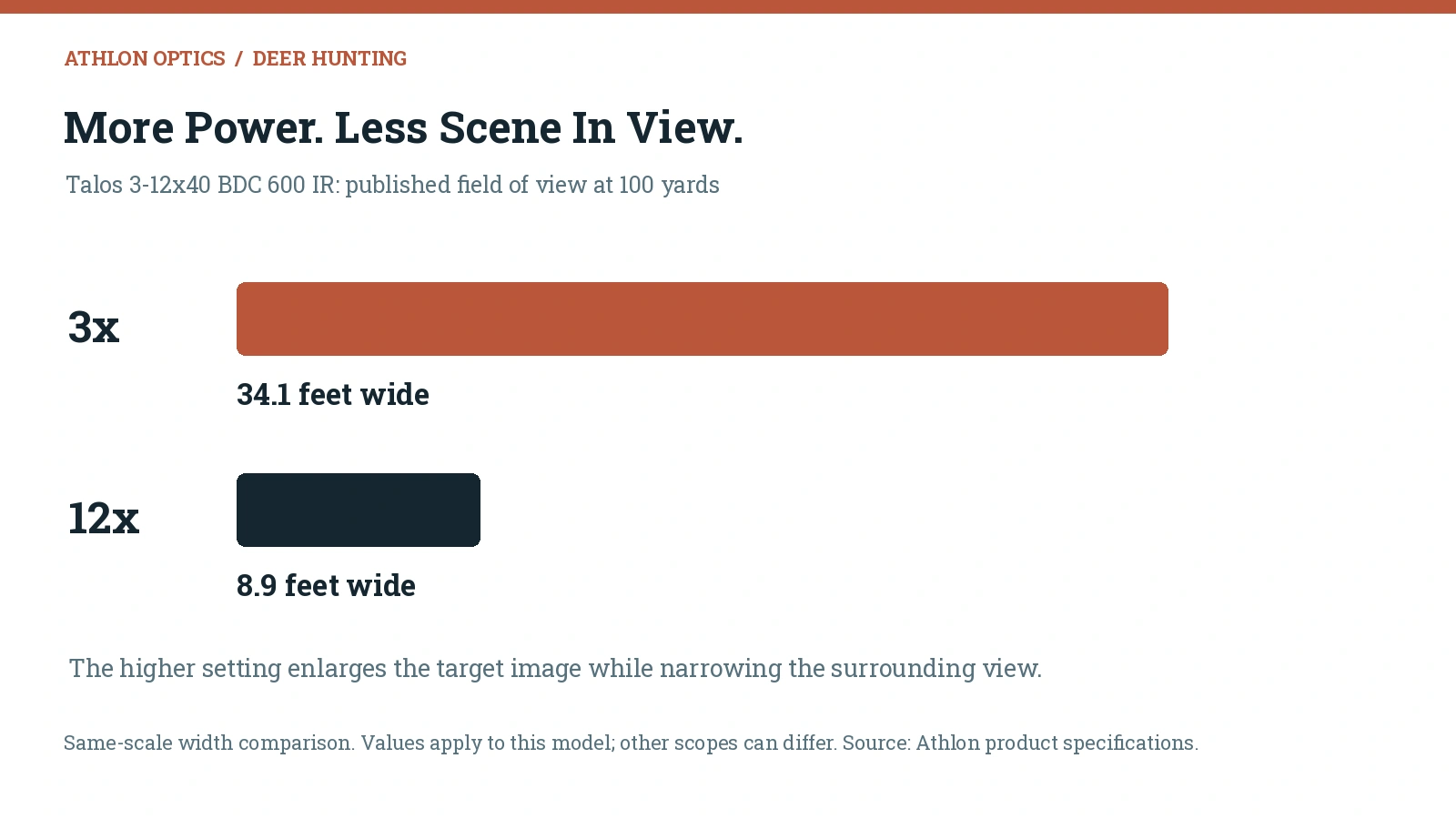
Field of view is the width of the scene visible through the scope at a stated distance. Within a variable-power scope, increasing magnification generally narrows that view.
For a real example, our Talos 3-12x40 BDC 600 IR lists a field of view of 34.1 feet at 3x and 8.9 feet at 12x, measured at 100 yards. At higher power, you see a much smaller portion of the surrounding scene.
Those are specifications for that model, not universal values for all 3-12x scopes. Optical design matters, so compare published figures rather than assuming equal magnification means equal field of view.
A wide view helps you locate a nearby deer. Continue checking your surroundings directly; the view through any scope is limited.
Why More Magnification Is Not Always Better
More power enlarges the target image, and it also makes existing movement more visible. It does not physically cause the rifle to shake more, but the apparent movement can make the aiming process feel less settled.
Higher settings can also narrow the field of view, make eye placement less forgiving on some scopes, and make atmospheric mirage more distracting.
Separate the consequences of turning up the power from the consequences of buying a different optic. Adjusting the power ring does not add weight; a model with more features or greater maximum power may be heavier, but you need to compare its specifications.
Choose a setting you can use effectively from your actual position. A magnified view cannot replace a dependable rest or consistent shooting technique.
Magnification and Low-Light Performance
Exit pupil is the diameter of the light beam leaving the eyepiece. Its nominal size is calculated by dividing objective diameter by magnification:
Exit pupil in millimeters = objective diameter in millimeters ÷ magnification
For a 40-millimeter objective:
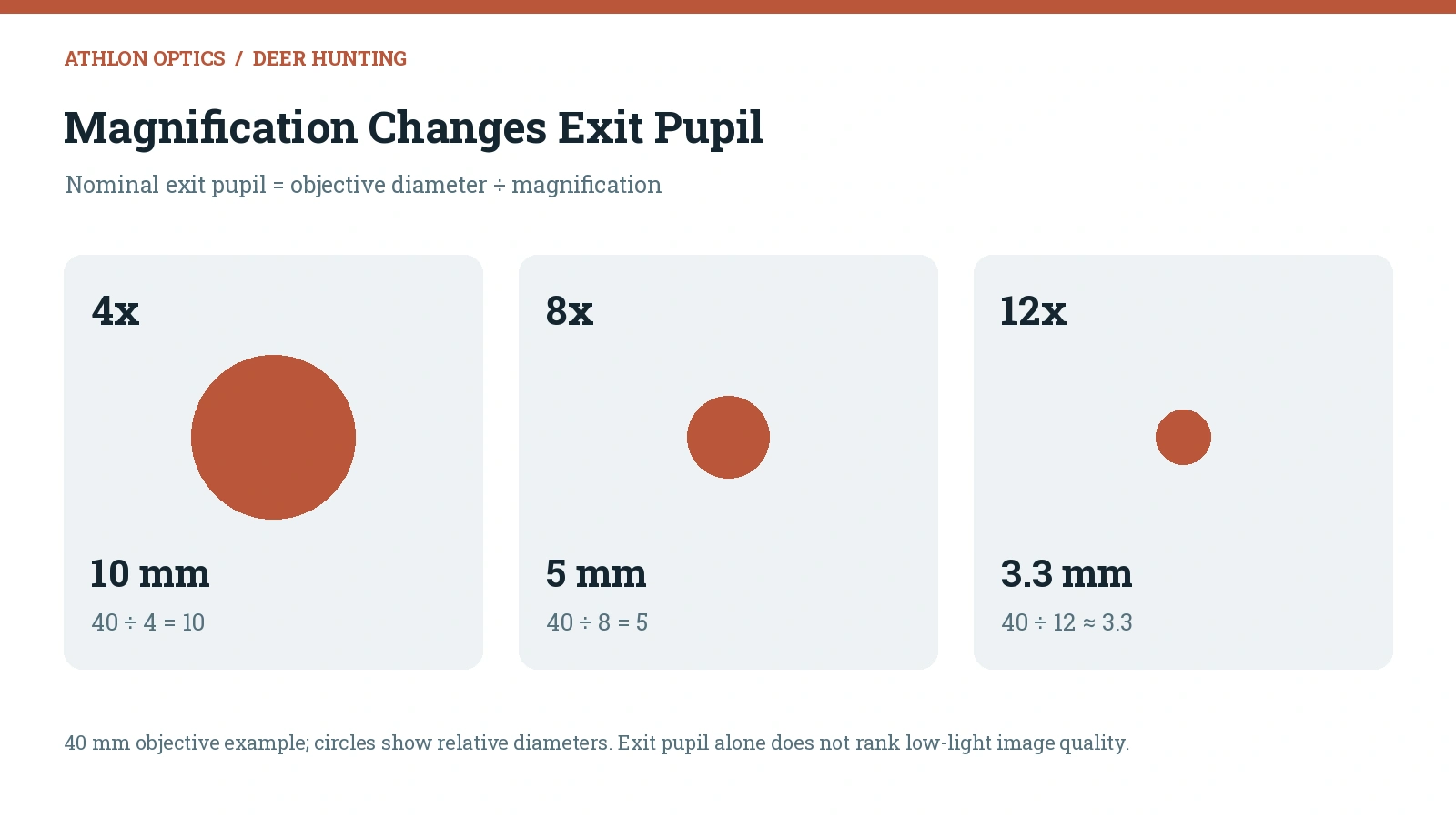
View the comparison as text
| Magnification | Calculation | Nominal Exit Pupil |
|---|---|---|
| 4x | 40 ÷ 4 | 10 mm |
| 8x | 40 ÷ 8 | 5 mm |
| 12x | 40 ÷ 12 | About 3.3 mm |
Reducing power can make the view easier to use in dim conditions, particularly when a small exit pupil is limiting the light reaching your eye. It does not guarantee a brighter useful image in every situation. Your pupil size, the detail you need to resolve, optical transmission, glare, and conditions all matter.
A 10-millimeter exit pupil does not mean your eye can use all of that light. If your pupil is smaller, it becomes the limiting opening. Bigger exit-pupil numbers are not a complete ranking of low-light performance.
Compare the image and reticle at the settings you expect to use. Set illumination only bright enough to see the aiming point without distracting glare, where available. Stay within legal shooting hours and stop when you cannot confidently identify the target and surrounding area.
Choosing an Objective Lens Size
A 40- or 42-millimeter objective is a useful size to compare for a general deer rifle. A 50-millimeter objective offers a larger nominal exit pupil at the same magnification, but the complete optic may be bulkier and may need more mounting clearance.
Ring height depends on the scope's outer dimensions, barrel and receiver clearance, mounting system, and rifle fit. The objective's stated lens diameter alone does not specify the rings you need.
Keep the rifle comfortable to shoulder with a repeatable cheek weld and proper eye relief. Compare complete setups rather than assuming the largest lens is always the better hunting choice.
First or Second Focal Plane for Deer Hunting?
In a first focal plane, or FFP, scope, the reticle and target image change apparent size together as you zoom. The reticle's angular measurements remain consistent across magnification settings.
In a second focal plane, or SFP, scope, the reticle stays the same apparent size as the target image changes. The labeled angular measurements or calibrated holdover references apply at the magnification specified by the manufacturer. Do not assume that setting is always maximum power.
A visible SFP reticle can be convenient for woods hunting. An FFP reticle can help hunters who use measured holds at different powers, but some designs appear fine at their lowest setting. Inspect the actual reticle rather than choosing from the focal-plane label alone.
Focal plane does not determine how much power you need. It determines how your reticle behaves as you change power. Verify any holdover references with your rifle and ammunition.
Athlon Scope Examples to Compare
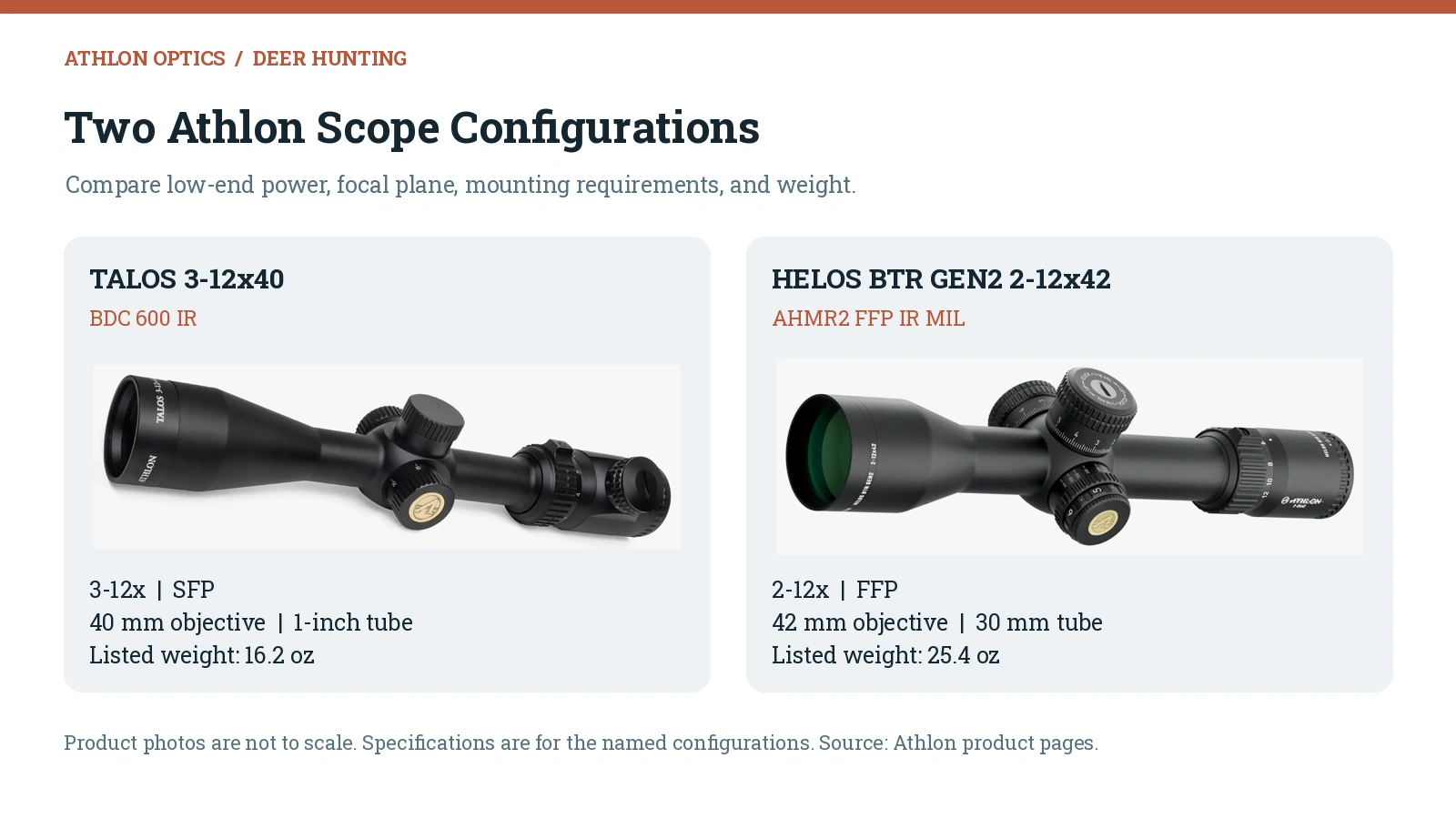
These two models illustrate different combinations of low-end power, reticle design, and weight. They are examples to evaluate, not a ranking or a guarantee of suitability for every deer rifle.
View the comparison as text
| Specification | Talos 3-12x40 BDC 600 IR | Helos BTR GEN2 2-12x42 AHMR2 FFP IR MIL |
|---|---|---|
| Magnification | 3-12x | 2-12x |
| Objective diameter | 40 mm | 42 mm |
| Focal plane | Second focal plane | First focal plane |
| Tube diameter | 1 inch | 30 mm |
| Listed weight | 16.2 oz | 25.4 oz |
The Talos provides a moderate zoom range in a lighter listed package. The Helos BTR GEN2 2-12x42 turns down to 2x and uses an FFP reticle, with additional weight to consider in the complete rifle setup.
Check the exact reticle, mounting requirements, and current product specifications before choosing. Product names that look similar can refer to different configurations.
A Practical Pre-Hunt Scope Checklist
Before hunting with a new scope or setup:
- Confirm a reliable zero with your hunting ammunition.
- Check eye relief and cheek weld from the positions you will use.
- Practice acquiring a target at low power with the rifle safely controlled.
- Test the magnification ring while wearing hunting gloves.
- Check reticle visibility against representative backgrounds.
- Confirm the required magnification for any SFP holdover references.
- Verify your shooting limits from realistic field rests and conditions.
Set the scope for the nearest likely encounter while waiting or moving through cover. When a more distant opportunity allows time, increase power only as much as needed.
Frequently Asked Questions
What Is the Best Scope Magnification for Deer Hunting?
There is no single best range for every deer hunt. A 3-9x is a useful starting point for many hunters; lower minimum power can help in thick cover, and a 3-15x or similar range may suit open terrain. Match the optic to your most common conditions and demonstrated ability.
Is 9x Enough at 200 Yards?
For many hunters, 9x provides sufficient aiming detail at 200 yards. Whether a shot is appropriate still depends on visibility, position, conditions, and verified accuracy with the rifle and ammunition.
What Scope Magnification Works Best in Thick Woods?
Prioritize a low minimum and a wide field of view. Ranges such as 1-6x, 1-8x, or 2-10x are useful comparisons. A 3-9x can also work when kept at its low setting.
Should I Keep My Scope on Maximum Power?
Usually not when a close encounter is possible. Start with a lower setting and increase power when there is time and it improves aiming detail without making the view difficult to use.
Does More Magnification Improve Low-Light Performance?
Increasing power reduces nominal exit pupil for a given objective. More power may reveal detail, but it can also make the view less usable in dim conditions. Compare the image and reticle at different settings rather than assuming maximum power is best.
Do I Need a 50-Millimeter Objective for Deer Hunting?
No. A well-chosen 40- or 42-millimeter scope can be practical for many deer rifles. A larger objective is an option to compare alongside optical quality, weight, mounting clearance, and rifle fit.
Choose for the Hunt You Actually Make
Start with the closest likely encounter and the terrain you hunt most often. Choose enough maximum magnification for your demonstrated shooting needs, then check field of view, reticle visibility, low-light usability, and rifle fit.
Our riflescope lineup includes different magnification ranges and reticle configurations. Compare the complete optic, practice from field positions, and carry a setting that leaves you ready for a nearby deer.
Find a magnification range and reticle that fit your terrain, rifle, and hunting style.