
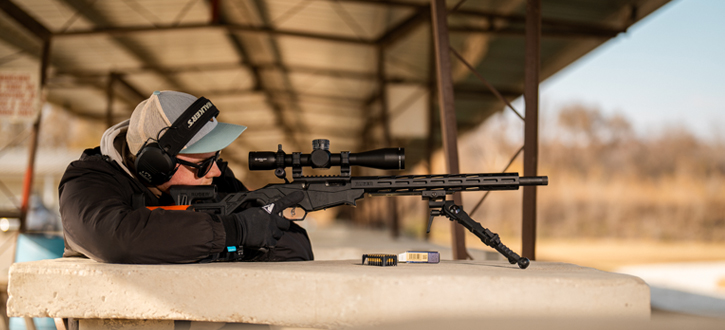
Choosing a rifle scope involves more than selecting a magnification range and objective lens size. Shooters must also consider glass quality, reticle design, turret configuration, and focal plane. The FFP vs SFP decision is especially important because focal plane determines how the reticle behaves when magnification changes.
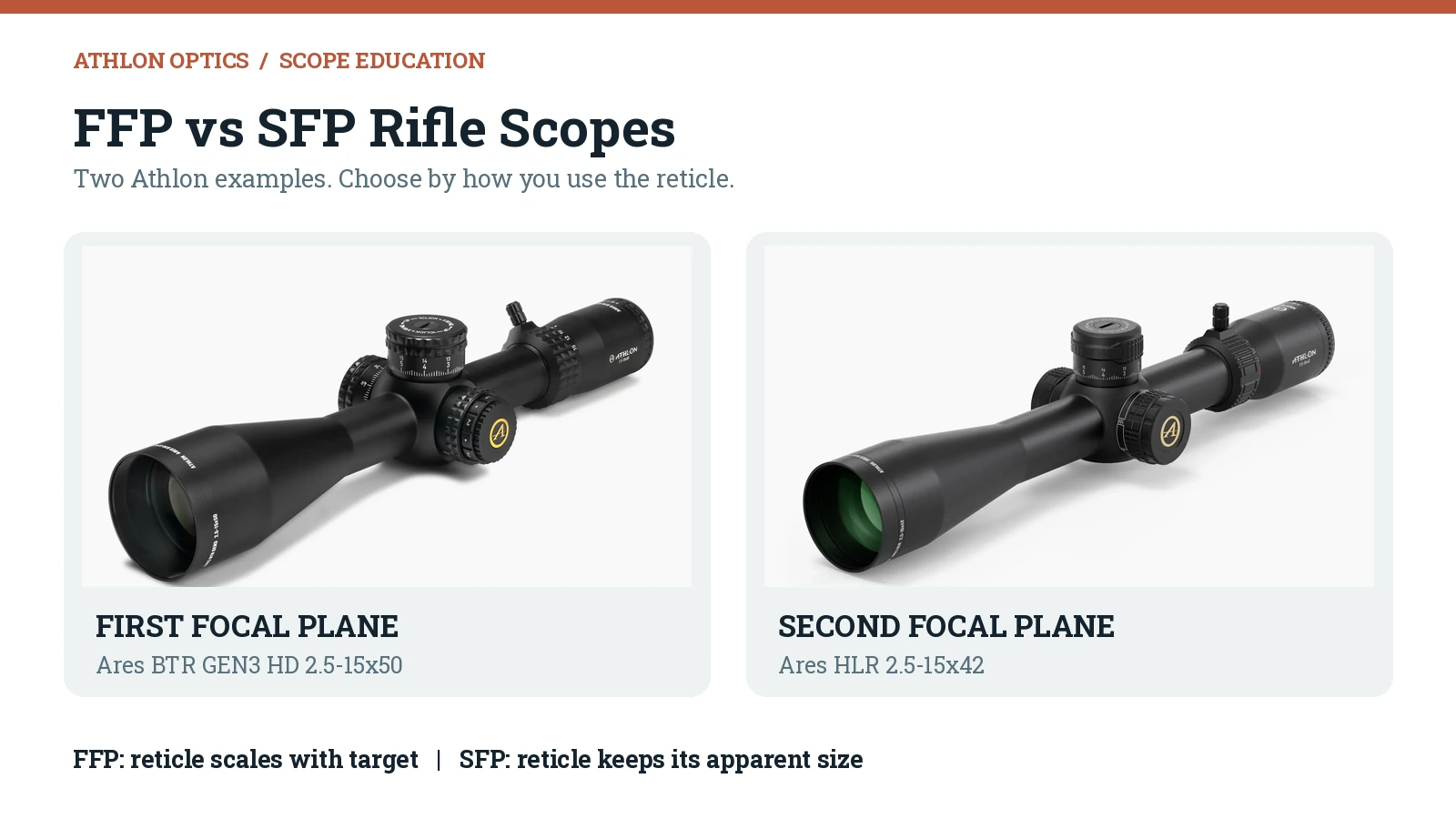
FFP stands for first focal plane, while SFP stands for second focal plane. In an FFP scope, the reticle appears to grow or shrink as the shooter adjusts magnification. In an SFP scope, the reticle maintains the same apparent size throughout the magnification range.
So, which option is right for you?
The answer depends on how you shoot, the distances you expect to encounter, whether you dial corrections or use reticle holds, and how important reticle visibility is at different magnification settings. Understanding first focal plane vs second focal plane optics will help you select the best rifle scope for hunting, target shooting, competition, or long-range use.
A variable-power rifle scope contains a series of lenses that magnify the target image. The reticle can be positioned in one of two locations within that optical system.
When comparing FFP vs SFP, the primary difference is the reticle’s position relative to the scope’s magnifying lenses. That position determines whether the reticle changes apparent size with the target image or maintains a consistent appearance.
Focal plane does not independently determine image quality, durability, light transmission, or adjustment accuracy. It describes how the reticle interacts with magnification.
Two scopes with identical magnification ranges and objective lens diameters can provide very different shooting experiences if one is a first-focal-plane design and the other is a second-focal-plane design.
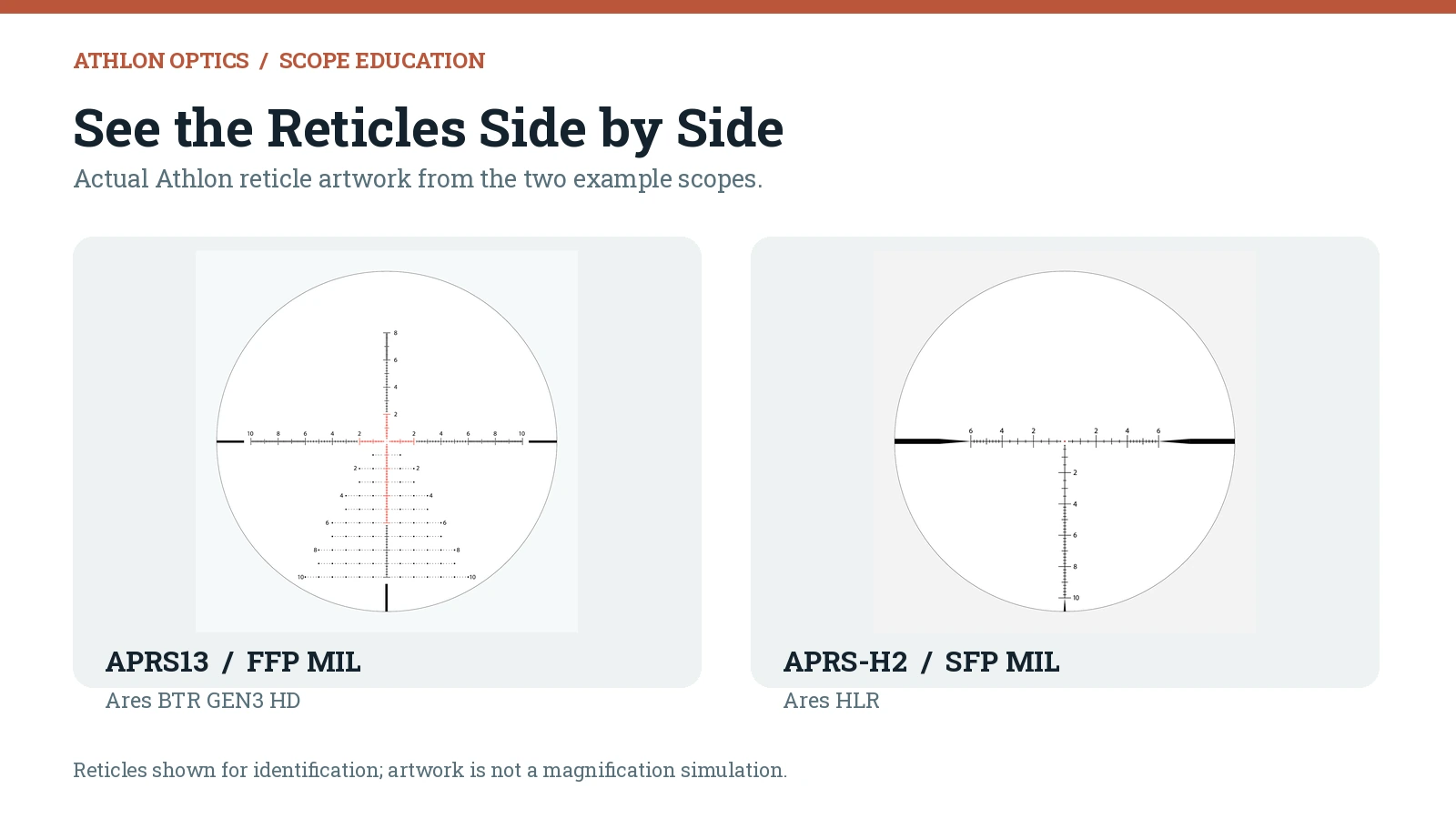
An FFP scope places the reticle in the first focal plane, in front of the scope’s magnifying lens assembly. When the shooter increases magnification, the reticle and target image appear to grow together. When magnification decreases, both appear smaller.
The reticle’s relationship to the target remains constant. This means its MIL or MOA subtensions remain accurate throughout the scope’s magnification range.
For example, a one-MIL mark represents one MIL whether the optic is set to 6x, 12x, or maximum magnification. The same principle applies to an MOA-based reticle.
This consistent measurement is the primary advantage of an FFP scope. Shooters can use the reticle for elevation, windage, range estimation, or moving-target holds without first returning to one designated magnification setting.
When evaluating FFP vs SFP for precision shooting, first-focal-plane optics provide several important advantages.
MIL or MOA references remain valid throughout the magnification range. A shooter can reduce magnification for a wider field of view while continuing to use the reticle for measured holds.
This can be valuable during a precision rifle match, where targets may appear at different distances and shooters must make decisions under time pressure.
An FFP scope allows the shooter to select magnification based on the target, environmental conditions, and shooting position without changing the mathematical value of the reticle.
For example, a shooter may reduce magnification to manage mirage, locate a target, or improve stability. The reticle references remain consistent.
Shooters who use the reticle instead of dialing every correction do not have to remember which magnification makes the marks accurate. This reduces one potential source of error.
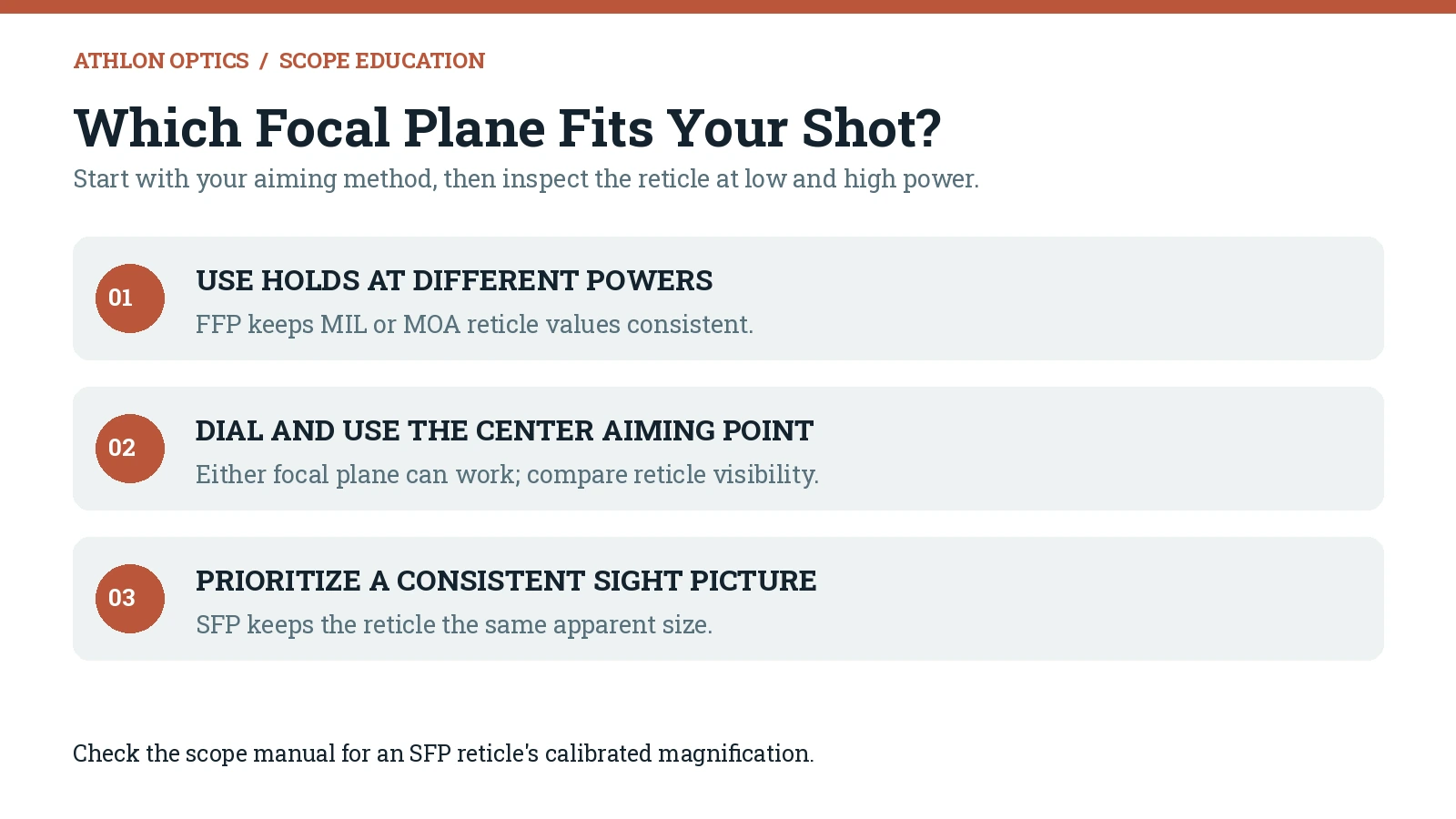
First-focal-plane designs are commonly used for long-range shooting, precision rifle competition, tactical applications, and hunting situations in which measured elevation and wind holds are required.
The changing reticle size can also create tradeoffs.
At low magnification, a detailed FFP reticle may appear extremely fine. It may be harder to see against brush, shadows, dark backgrounds, or an animal’s hide. Illumination and a well-designed center aiming point can help address this issue.
At high magnification, the reticle appears larger. Heavy lines or a large center aiming point may cover more of a small target than some shooters prefer.
Reticle design is therefore especially important when selecting an FFP scope. A well-designed reticle must remain visible at low power without becoming overly heavy at maximum magnification.
First-focal-plane optics may also cost more than comparable second-focal-plane options, although price differences depend on the product family, features, and construction.