

Athlon Optics / Scope Education
What Does 4-16x50 Mean on a Rifle Scope?
Understand magnification, objective lens size, and what the numbers mean for your next optic.
A 4-16x50 rifle scope has variable magnification from 4x to 16x and a 50mm objective lens. The first two numbers describe its lowest and highest magnification settings. The number after the “x” is the diameter of the front lens in millimeters.
Those specifications tell you how much the scope can enlarge your view and the size of its objective lens. They do not tell you its overall optical quality, focal plane, or maximum effective shooting distance.
Here is how to read the numbers and decide whether this type of scope fits your rifle and the way you shoot.
How to Read Rifle Scope Numbers
Most variable-power rifle scopes use this format:
Minimum magnification – maximum magnification x objective lens diameter
For a 4-16x50 scope, the breakdown is:
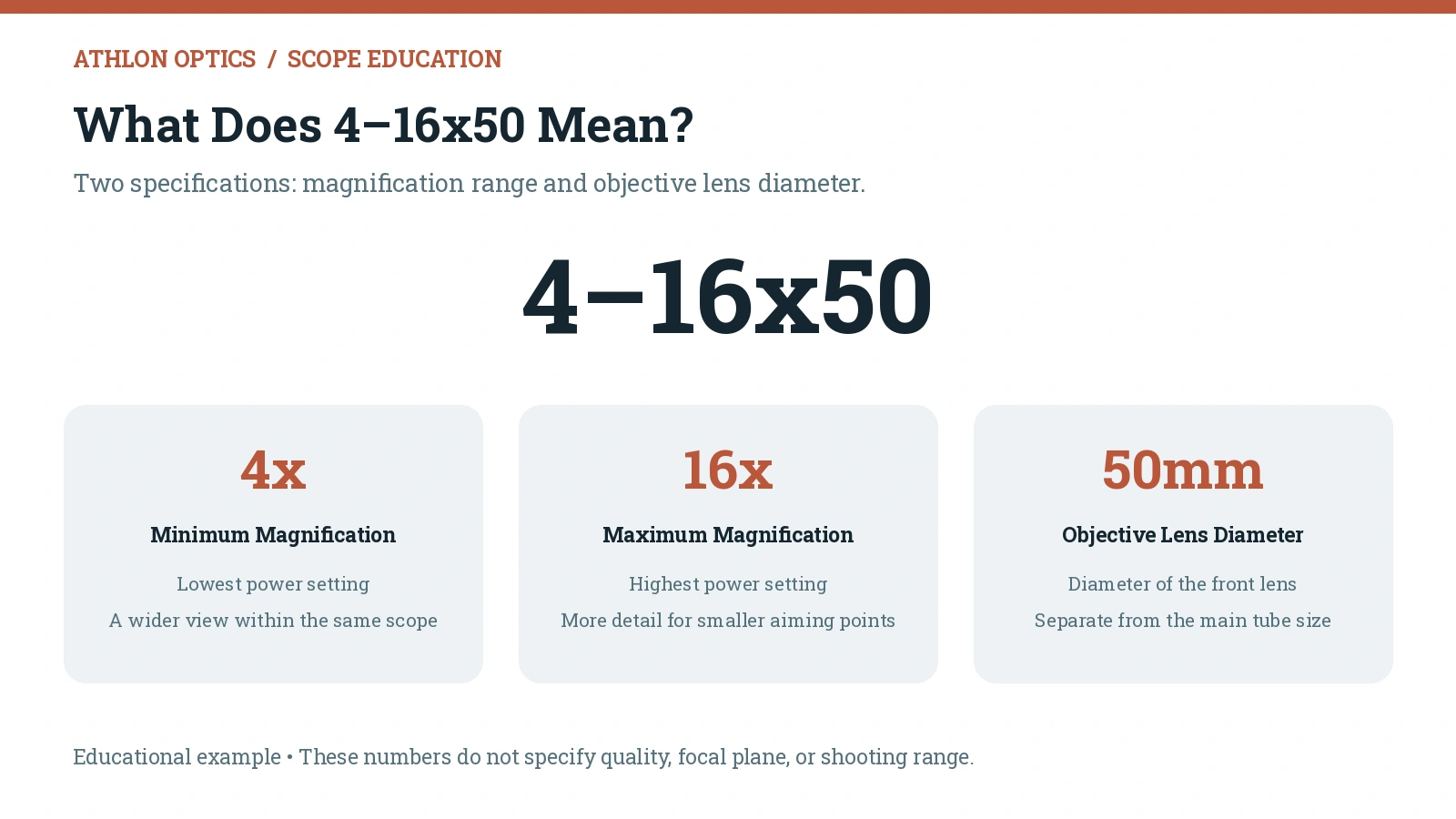
The “x” is read as “times” and separates the magnification specification from the lens diameter. You may also see the same configuration written as 4–16×50 or 4-16x50mm.
Once you understand the format, you can read other common configurations:
| Scope Marking | Magnification | Objective Lens Diameter |
|---|---|---|
| 3-9x40 | Variable, 3x to 9x | 40mm |
| 4-16x40 | Variable, 4x to 16x | 40mm |
| 4-16x50 | Variable, 4x to 16x | 50mm |
| 6-24x50 | Variable, 6x to 24x | 50mm |
| 4x32 | Fixed at 4x | 32mm |
A range before the “x” indicates variable magnification. A single number, such as 4x32, indicates fixed magnification.
Zoom ratio is another specification you may encounter. A 4-16x scope has a 4:1 zoom ratio because 16 divided by 4 equals 4. That does not mean its maximum magnification is 4x.
Rifle Scope Magnification Explained: 4x vs. 16x
Magnification enlarges the apparent size of the target. At 4x, the target appears approximately four times as large as it does to the unaided eye; at 16x, it appears approximately 16 times as large. Rotate the magnification ring to select a setting between those limits.
For perspective, a target 400 yards away at 4x has roughly the apparent size it would have at 100 yards without magnification. Its actual distance remains 400 yards, and magnification does not change the bullet's trajectory.
When Lower Magnification Helps
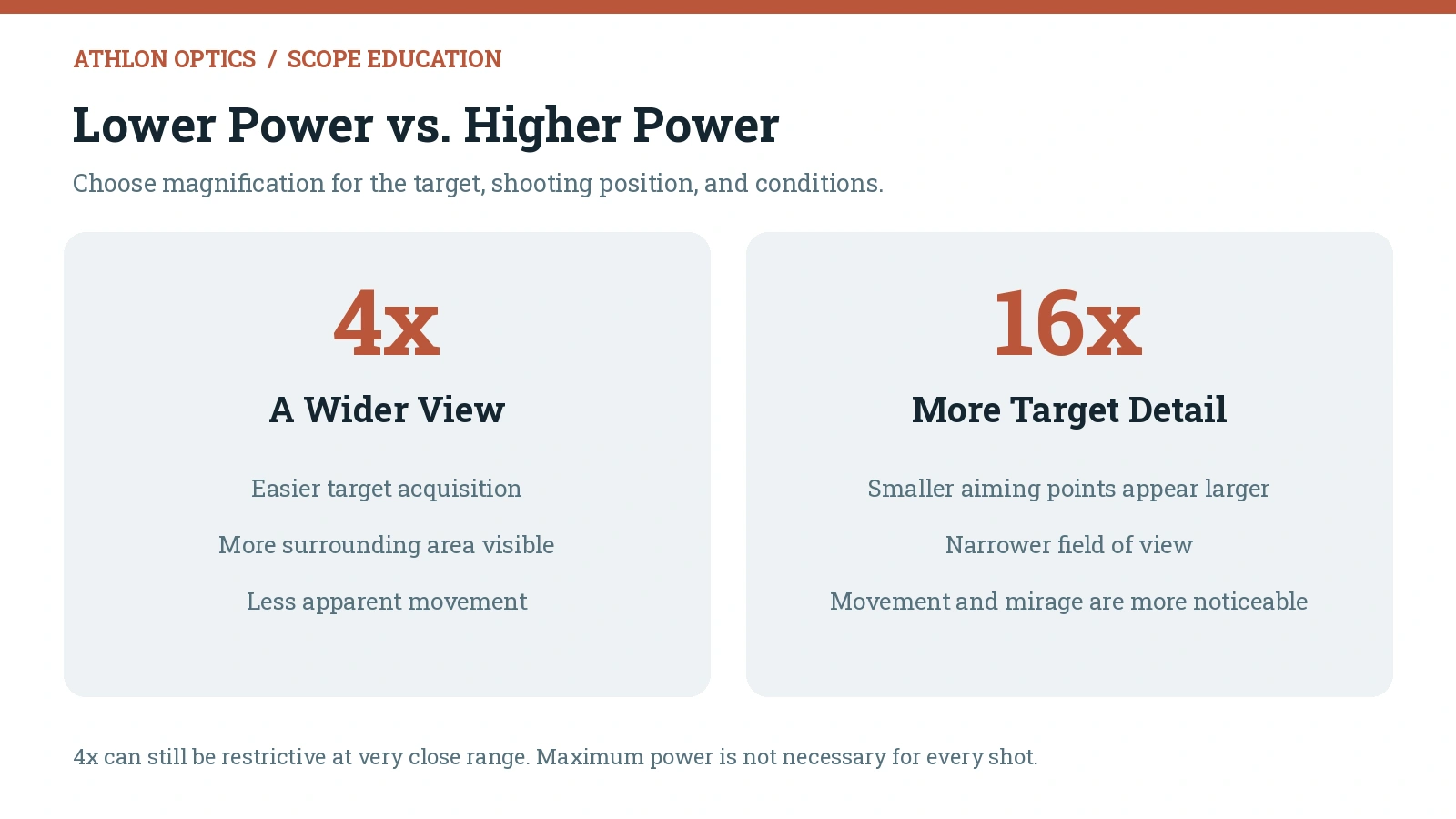
Within the same scope, lower power generally provides a wider field of view. That makes it easier to locate a target and see the area around it. It also makes movement from an unsupported position less noticeable in the sight picture.
The 4x setting can be useful for hunting in mixed terrain, acquiring closer targets, or getting settled before increasing power. However, 4x may still be more magnification than you want for very close encounters in dense cover. If those situations make up most of your hunting, compare scopes with a lower minimum power.
When Higher Magnification Helps
Higher power can reveal more target detail and help you see a smaller aiming point. Settings near 16x can be useful for shooting groups from a supported position, small-target shooting, or predator and varmint hunting in open terrain.
The tradeoffs are a narrower field of view, more noticeable movement, and a smaller exit pupil. Mirage can also make high power less useful. Maximum magnification is an option to use when conditions support it, rather than a setting you need for every shot.
What Does the 50 Mean on a Rifle Scope?
The 50 means the objective lens measures 50 millimeters in diameter. This is the front lens, facing toward the target.
A larger objective can admit more light than a smaller one, with other factors equal. Whether you see a brighter or more useful image also depends on magnification, light transmission, lens coatings, optical design, and your eye.
A 50mm objective is not a guarantee of better low-light performance than a 40mm or 44mm scope. Contrast and resolution matter too: a bright image is less useful if important details are poorly defined.
The objective lens diameter is also different from the scope's tube diameter. A 50mm objective does not mean you need 50mm rings. Rings must match the main tube, while mounting height must provide clearance for the objective housing and your rifle's components.
How Magnification Affects Exit Pupil and Low-Light Viewing
Exit pupil is the diameter of the light beam leaving the eyepiece. A useful estimate is:
Exit pupil = objective lens diameter ÷ magnification
For a 4-16x50 scope:
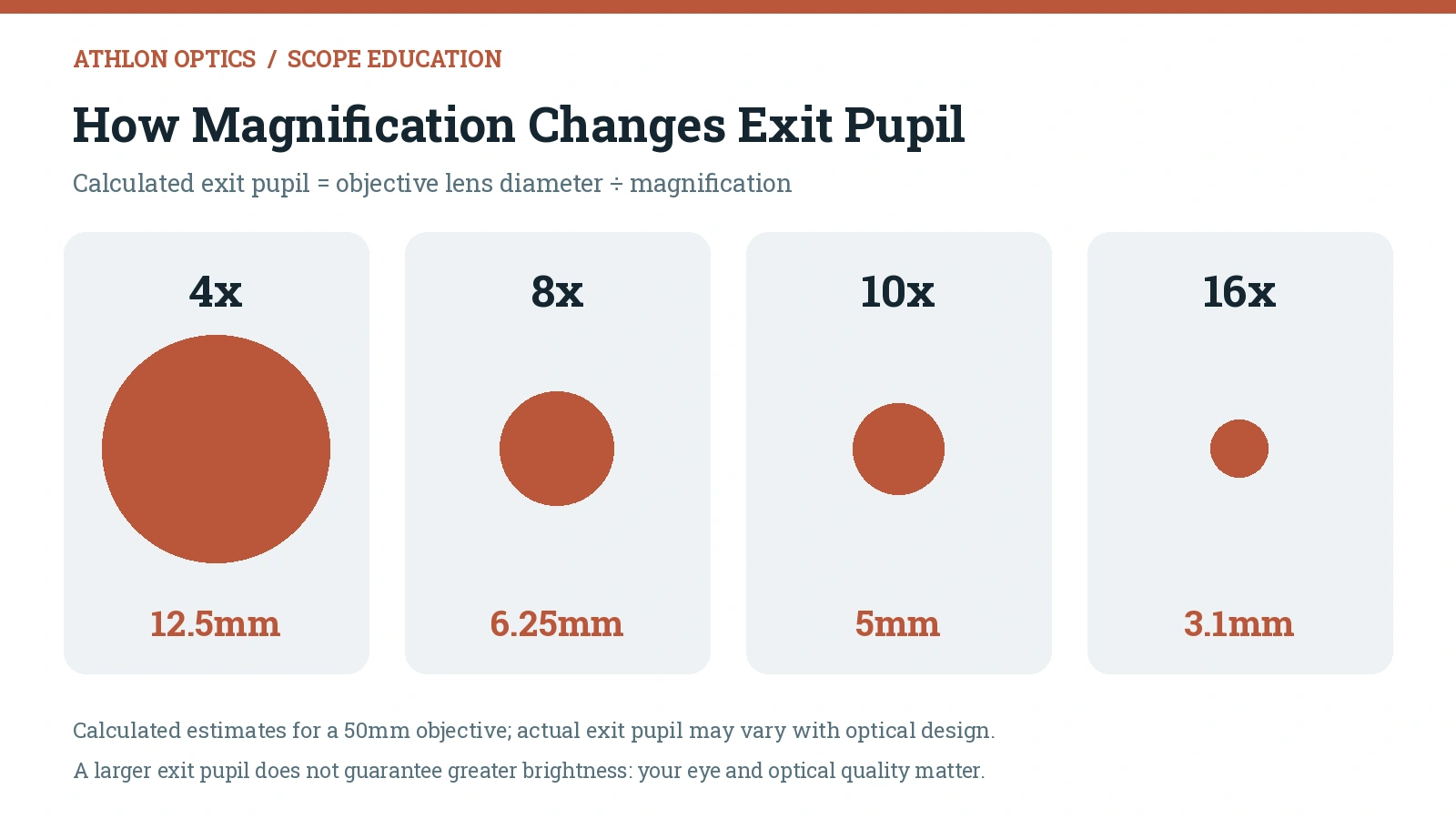
These are calculated estimates; the optical design can limit the actual exit pupil, particularly at low power.
Lowering magnification increases the calculated exit pupil and may make the image easier to acquire in fading light. Your eye can only accept the portion of that light beam that fits through its own pupil, so an increasingly large exit pupil does not produce unlimited brightness.
In practice, compare settings. A moderate power may provide a more usable balance of target detail, brightness, and comfortable eye position than maximum power.
Is a 4-16x50 Scope Good for Hunting and Target Shooting?
This configuration can suit several applications, but the best choice depends on the complete optic and your typical conditions.
- Big-game hunting in mixed or open terrain: Lower power helps with target acquisition, while higher settings provide more detail when a supported shot allows time to adjust.
- Predator and varmint hunting: Additional magnification can help with smaller targets. Consider minimum power as well if animals commonly appear close.
- Recreational target shooting: The range of settings provides flexibility for different target sizes and distances.
- Longer-range shooting: 16x may provide sufficient detail for some targets, but reticle design, turret tracking, adjustment range, parallax control, and optical quality also matter.
For a rifle carried long distances, consider weight and balance. For frequent close-range use, prioritize a suitable low-power setting and field of view. Choose around your most common use rather than the largest numbers on the box.
Does a 4-16x50 Scope Have a Maximum Range?
No. The designation does not establish a maximum shooting distance.
Useful magnification depends on target size, visibility, eyesight, and shooting position. Effective shooting range also depends on the rifle, ammunition, wind, ballistic information, and the shooter's demonstrated ability.
Seeing a target through a 16x scope does not establish that you can make an accurate shot at that distance. Use magnification to support target identification and aiming within your capabilities.
What Else Should You Check Before Choosing a Scope?
Two scopes with identical magnification and objective size can differ substantially. Compare these specifications before making your choice:
- Field of view: Check the actual specification, usually given as feet at 100 yards or meters at 100 meters. Matching magnification ranges do not guarantee identical views.
- Eye relief: Confirm the scope provides appropriate eye relief for your rifle and a comfortable position behind the eyepiece.
- Focal plane: First focal plane reticle subtensions remain consistent across magnification settings. Second focal plane subtensions are calibrated at a specified setting; consult the reticle manual before using measured holds.
- Parallax adjustment: Side focus or an adjustable objective can help reduce parallax error at different distances. Check the adjustment range for your intended use.
- Reticle and turrets: Consider whether you primarily use a center aiming point, measured holds, or dialed corrections. Match the reticle and adjustment units to your shooting process.
- Mounting fit: Check main tube diameter, outside objective housing diameter, base and ring height, barrel and bolt clearance, and cheek weld. Lens diameter alone cannot determine the required ring height.
- Optical and mechanical performance: Evaluate clarity, contrast, coatings, adjustment repeatability, durability, and the scope's construction.
Frequently Asked Questions
What Does 4-16x50 Mean on a Rifle Scope?
It means the scope adjusts from 4x to 16x magnification and has a 50mm objective lens. It does not specify tube diameter, focal plane, or shooting range.
What Is the Difference Between 4-16x40 and 4-16x50?
Both have the same stated magnification range. The first has a 40mm objective; the second has a 50mm objective. With other factors equal, the 50mm lens provides a larger exit pupil at the same power, but may require more mounting clearance.
Is a 50mm Objective Better Than a 40mm Objective?
It can offer an advantage at higher power or in low light, depending on optical quality and your eye's pupil size. A smaller scope may be a better fit when compact size, lower mounting height, or carrying weight is the priority.
Is 16x Too Much Magnification for Deer Hunting?
It may be unnecessary for many shots, especially at close range. A variable scope lets you keep power lower for a wider view and increase it when target distance, support, and conditions make additional detail useful.
What Size Rings Does a 4-16x50 Scope Need?
Ring diameter must match the main tube diameter listed for that model. Ring height depends on the objective housing, rifle, bases, and required clearance. The 4-16x50 marking alone does not provide enough information to choose rings.
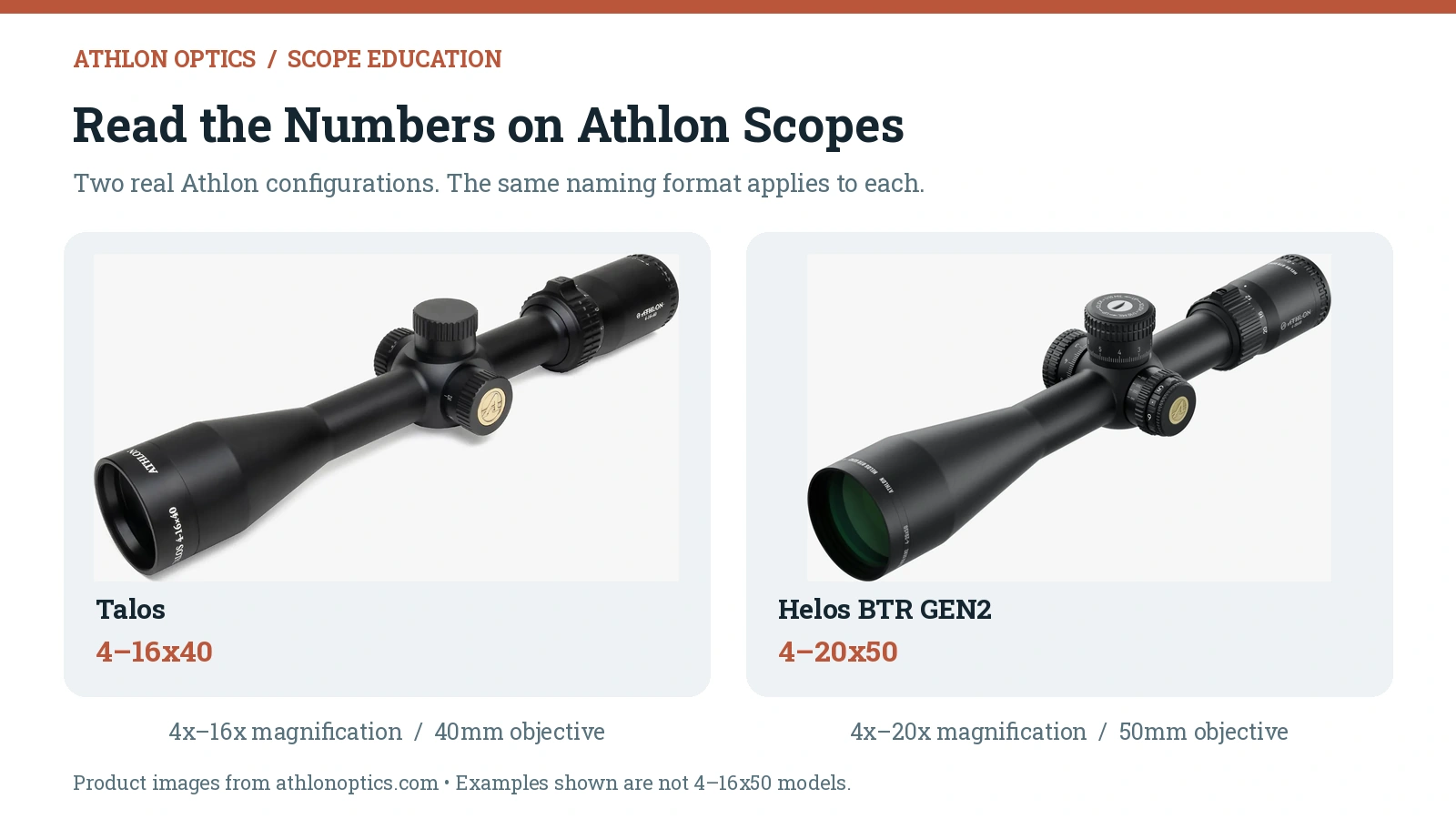
Find the Right Athlon Rifle Scope
Understanding scope numbers gives you a useful starting point. Next, compare the magnification range, reticle, focal plane, mounting fit, and overall performance against your needs.
Explore our rifle scopes or use the Athlon Optics Scope Finder to narrow your options. Review each model's specifications and reticle details before choosing the optic for your rifle.
Compare Athlon optics by magnification, application, and the features that matter to your setup.