
Athlon Optics / Scope Education
MOA vs MIL: Which Rifle Scope System Should You Choose?
Understand angular units, turret clicks, and how to choose a consistent system for your rifle scope.
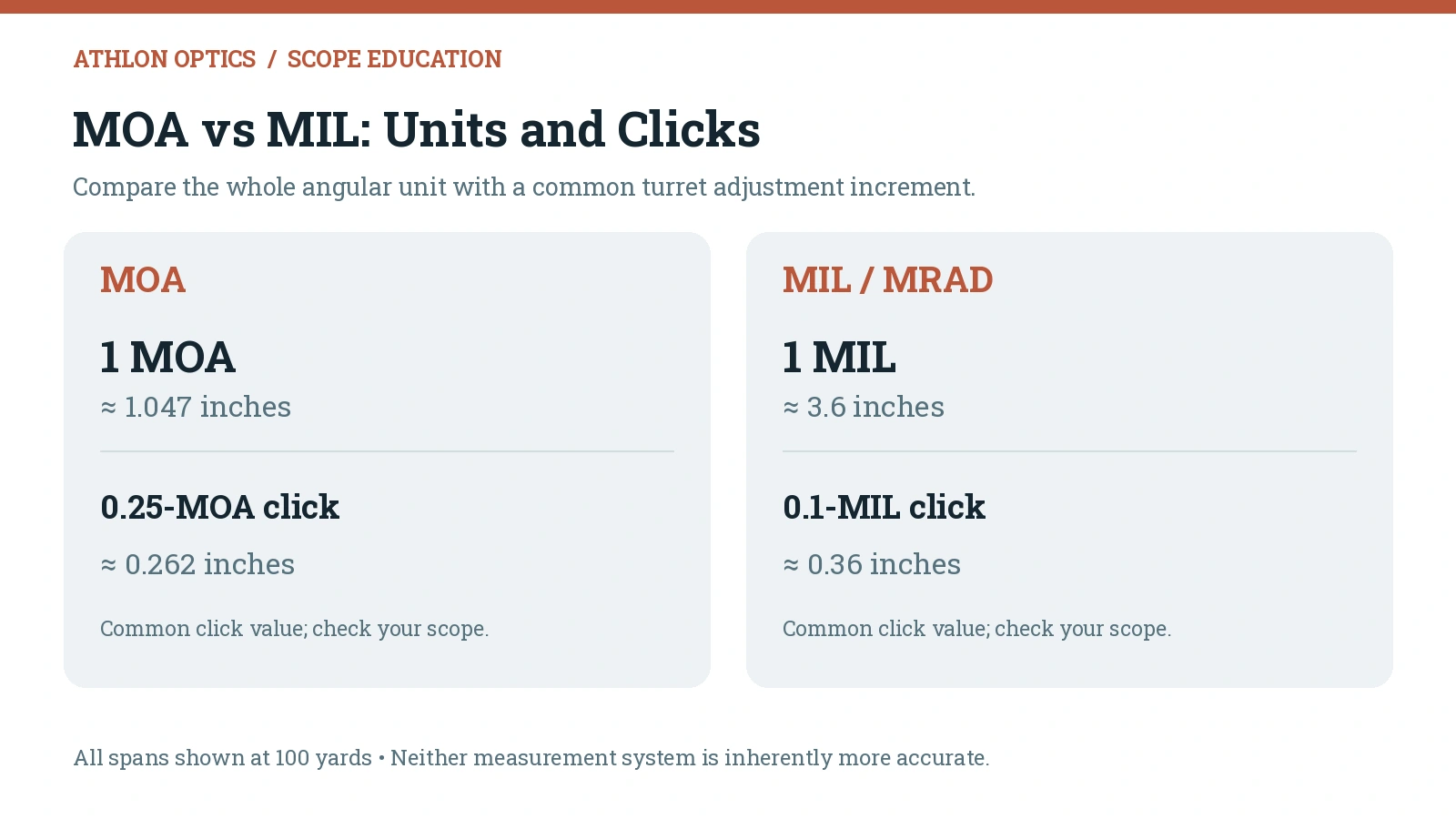
MOA and MIL are two angular measurement systems used in rifle scope reticles and turret adjustments. One MOA spans approximately 1.047 inches at 100 yards, while one MIL spans approximately 3.6 inches at the same distance. MIL and MRAD mean the same thing in modern rifle scope terminology.
Both systems can support precise aiming and adjustments. The best choice is usually the one you understand, use consistently, and share with your shooting partners. Match your reticle, turrets, and ballistic data so you can apply corrections without unnecessary conversions.
This guide explains the differences, compares common click values, and helps you choose a system for hunting or target shooting.
MOA vs MIL at a Glance
MOA stands for minute of angle. MIL is short for milliradian, also written as MRAD. Both describe angles rather than fixed distances in inches or centimeters.
The main differences are the size of each angular unit and the adjustment increments commonly used on scope turrets:
View the comparison values as text
| Specification | MOA | MIL / MRAD |
|---|---|---|
| Full unit at 100 yards | Approximately 1.047 inches | Approximately 3.6 inches |
| Common turret click | 0.25 MOA | 0.1 MIL |
| One common click at 100 yards | Approximately 0.262 inches | Approximately 0.36 inches |
| Unit conversion | 1 MOA ≈ 0.291 MIL | 1 MIL ≈ 3.438 MOA |
These are common click values, not universal specifications. Check the turret markings and manual for your individual scope.
Why Distance Matters for Angular Measurements
Imagine two lines extending from the same point at a fixed angle. As they travel farther, the gap between them grows even though the angle stays the same.
Scope corrections work in a similar way. A 1-MOA or 1-MIL adjustment represents the same angle at every distance, but the corresponding distance on the target grows with range.
That is why “one MOA equals one inch” is incomplete. It is a rounded approximation at 100 yards, not a fixed value at every distance.
Neither unit is restricted to imperial or metric measurements. You can use MOA or MIL with yards, meters, inches, or centimeters as long as the calculations use consistent units.
What Is MOA on a Rifle Scope?
MOA means minute of angle. One degree contains 60 minutes, so one MOA is 1/60 of a degree.
At 100 yards, one MOA spans approximately 1.047 inches. The familiar “one inch at 100 yards” shortcut can be useful for a rough estimate, but it introduces a rounding difference that matters more as distances and corrections increase.
Many MOA scopes use 0.25-MOA clicks. Four clicks on such a turret equal one MOA. Other scopes use different increments, including 0.125 or 0.5 MOA.
A Simple MOA Adjustment Example
Suppose a target group is measured through the reticle as 2 MOA below the aiming point. With matching 0.25-MOA turrets, the elevation correction is 2 MOA up, or eight clicks.
If you measure the group in inches instead, include the target distance in the calculation. A group 2 inches low at 100 yards needs approximately 1.91 MOA of correction; the nearest quarter-MOA setting is 2 MOA. Verify the result with another group.
MOA can feel familiar to shooters accustomed to yards and inches. That familiarity is useful, but it does not make MOA an imperial unit or automatically improve accuracy.
What Is MIL or MRAD on a Rifle Scope?
A milliradian is one-thousandth of a radian. In rifle optics, MIL and MRAD refer to this same angular unit.
One MIL spans approximately 3.6 inches at 100 yards, or 10 centimeters at 100 meters. These are practical small-angle values used for scope calculations.
Many MIL scopes use 0.1-MIL clicks. Ten clicks equal one MIL. At 100 yards, a 0.1-MIL click corresponds to approximately 0.36 inches; at 100 meters, it corresponds to approximately 1 centimeter.
A Simple MIL Adjustment Example
Suppose the reticle shows a target group 0.7 MIL below the aiming point. With matching 0.1-MIL turrets, the elevation correction is 0.7 MIL up, or seven clicks.
You do not need to convert the measured error into inches first. Measure in MIL, adjust in MIL, and verify the correction.
MIL corrections often use smaller numerical values than equivalent MOA corrections. For example, 5.2 MIL is approximately 17.88 MOA. Some shooters find decimal values easier to record and communicate, especially when everyone uses the same system.
MOA and MIL Values at Different Distances
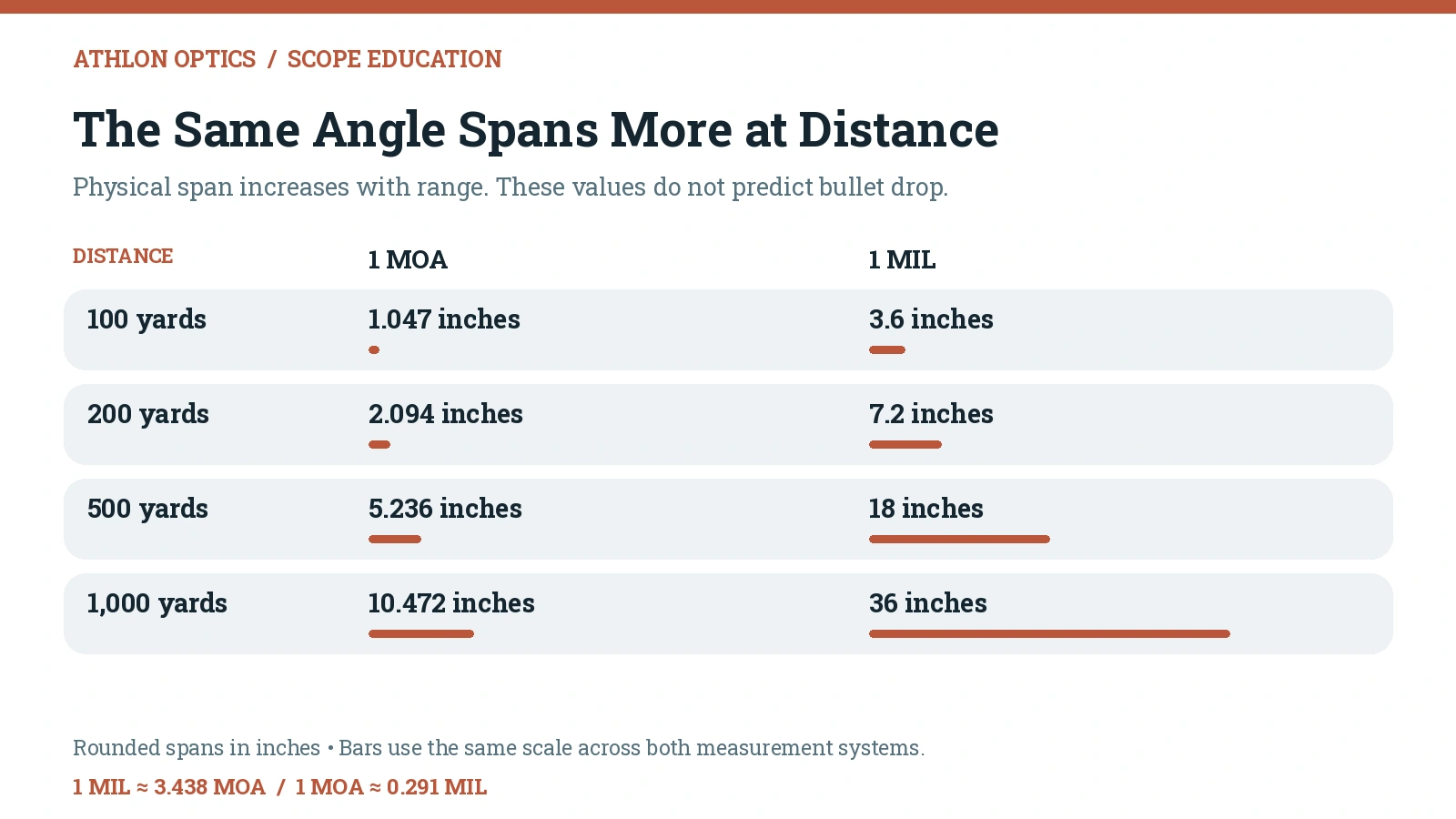
The physical span of an angular unit increases in proportion to distance. These rounded values show the relationship:
View the comparison values as text
| Distance | Span of 1 MOA | Span of 1 MIL |
|---|---|---|
| 100 yards | 1.047 inches | 3.6 inches |
| 200 yards | 2.094 inches | 7.2 inches |
| 500 yards | 5.236 inches | 18 inches |
| 1,000 yards | 10.472 inches | 36 inches |
These numbers describe angular spans, not predicted bullet drop. Actual elevation and wind corrections require data for your rifle, ammunition, distance, and conditions.
For quick calculations:
- MOA span in inches ≈ MOA × 1.0472 × distance in yards ÷ 100.
- MIL span in inches ≈ MIL × 3.6 × distance in yards ÷ 100.
- MIL span in centimeters ≈ MIL × distance in meters ÷ 10.
How to Convert MOA to MIL or MIL to MOA
Use these practical conversion factors:
- MIL to MOA: multiply by 3.43775.
- MOA to MIL: divide by 3.43775.
For example, 1 MIL is approximately 3.438 MOA, and 10 MOA is approximately 2.909 MIL.
A converted value may fall between your turret's click increments. Round to an available setting, then verify the adjustment. Better still, configure your ballistic calculator to output the same units as your scope so conversion is rarely necessary.
Is MOA More Accurate Than MIL?
Neither angular system is inherently more accurate.
A common 0.25-MOA click is finer than a common 0.1-MIL click: approximately 0.262 inches versus 0.36 inches at 100 yards. This compares two particular adjustment increments, not the accuracy of every MOA scope against every MIL scope.
Finer increments can matter for certain small-target applications. Practical results also depend on turret tracking, rifle and ammunition consistency, shooting position, conditions, and shooter skill.
Choose the reticle and click value that fit your application, then evaluate the scope's optical and mechanical performance.
Why Your Reticle and Turrets Should Match
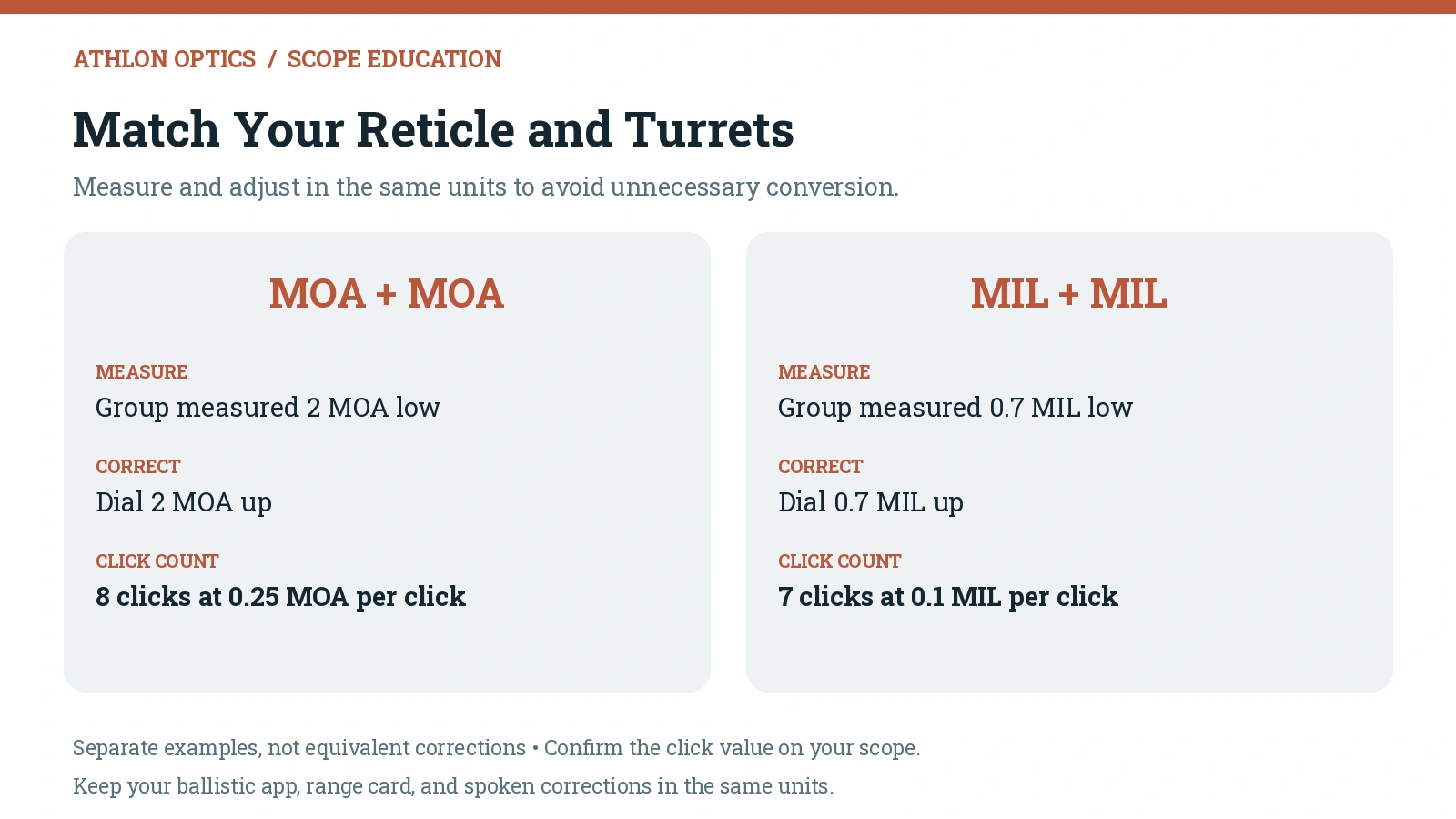
A matched system uses MOA markings with MOA turrets, or MIL markings with MIL turrets. That lets you measure an error through the scope and dial the corresponding correction directly.
For example:
- MOA reticle and turrets: a group 2 MOA low requires 2 MOA up, or eight clicks on a 0.25-MOA turret.
- MIL reticle and turrets: a group 0.7 MIL low requires 0.7 MIL up, or seven clicks on a 0.1-MIL turret.
These are separate examples, not equivalent corrections.
A mixed system can still work, but it adds conversion. A 0.7-MIL error is approximately 2.41 MOA. On a quarter-MOA turret, that falls between 2.25 and 2.5 MOA.
Keep your scope, ballistic app, range card, and spoken corrections in the same units whenever possible. When communicating with a spotter, be clear whether the call describes where the impact landed or which direction to correct.
Reticle Holds and Focal Plane
You can apply a correction with the reticle instead of dialing the turret. If verified ballistic data calls for an elevation hold of 4.5 MIL, use the appropriate reticle reference with the turret at its intended baseline setting. MOA holds work the same way using MOA data.
Do not apply the same elevation correction twice by dialing it and also holding the full amount. Dialing elevation while holding wind is a separate, commonly used approach.
Focal plane affects the scale of measured reticle marks:
- First focal plane: reticle subtensions remain consistent throughout the magnification range.
- Second focal plane: the stated subtensions apply at the manufacturer's specified magnification. Check the reticle manual before using holds or measuring corrections at other settings.
Learn more in our FFP vs SFP rifle scope guide.
Should You Choose MOA or MIL for Hunting?
Start with the system you already understand and the way you apply corrections.
MOA may feel familiar if you think in yards and inches or already use MOA scopes. MIL may be convenient if your practice, ballistic data, and hunting partners already use MIL.
For hunters who mostly use the center aiming point within a verified practical range, reticle visibility, low-light performance, eye relief, weight, and mounting fit may matter more than the unit printed on the turret.
Before choosing, ask:
- Does the reticle suit the terrain and magnifications I use?
- Are the reticle, turrets, and ballistic data matched?
- Do I understand my rifle's confirmed trajectory and limitations?
- Can I apply the required correction confidently in the time available?
Neither system extends your capabilities by itself. Practice and confirmed performance with your setup determine which shots you can make reliably.
Which Is Better for Long-Range Target Shooting?
Both MOA and MIL can work for long-range target shooting. MIL is common in practical precision rifle circles, making it a convenient choice when your spotter, instructor, or shooting partners use it. An established MOA setup can work just as well without switching systems.
More important than the unit name are reliable tracking, adequate usable elevation, a readable reticle, parallax adjustment, and suitable optical performance.
Total Elevation vs. Usable Elevation
Advertised elevation travel is usually the scope's total adjustment range, not the amount you can dial upward after zeroing.
If a scope has 100 MOA of total travel, its mechanical midpoint divides that travel roughly into 50 MOA in each direction. Your rifle's zero may sit elsewhere within the range. A 30-MIL scope likewise does not automatically provide 30 MIL above zero.
A correctly chosen inclined base or mount can shift the zero's position within that range to preserve more upward adjustment. Its suitability depends on the scope and rifle setup. Check the available adjustment after mounting and zeroing.
How to Choose Between MOA and MIL
Use this short checklist:
- Start with the system you already use confidently.
- Consider what your shooting partners or instructor use.
- Match the reticle and turrets, and set your ballistic app to the same units.
- Check the individual scope's click value, reticle scale, focal plane, and usable adjustment range.
- Practice measuring, dialing, and holding corrections with that setup.
The goal is a system you can read and use consistently. Familiarity and repeatability are more useful than choosing a unit simply because it sounds more advanced.
Frequently Asked Questions
Are MIL and MRAD the Same?
Yes. In modern rifle scope terminology, MIL and MRAD refer to milliradians. Check the individual scope's markings and manual for its click value and reticle details.
How Many MOA Are in One MIL?
One MIL is approximately 3.438 MOA. To convert MIL to MOA, multiply by 3.43775.
How Much Is One MOA at 100 Yards?
One MOA spans approximately 1.047 inches at 100 yards. A 0.25-MOA click corresponds to approximately 0.262 inches at that distance.
How Much Is One MIL at 100 Yards?
One MIL spans approximately 3.6 inches at 100 yards. A 0.1-MIL click corresponds to approximately 0.36 inches at that distance.
Can You Use MIL Scopes With Yards and Inches?
Yes. MIL is an angular unit and works with imperial or metric measurements. It is not restricted to meters or centimeters.
Is MOA or MIL Better for Hunting?
Neither is universally better. Choose the system you understand, keep your reticle and turrets matched, and use confirmed ballistic data in the same units.
Do MIL Scopes Shoot Farther Than MOA Scopes?
No. The measurement unit does not determine range. Usable adjustment, rifle and ammunition performance, conditions, and shooter ability matter more.
Find Your Athlon MOA or MIL Scope
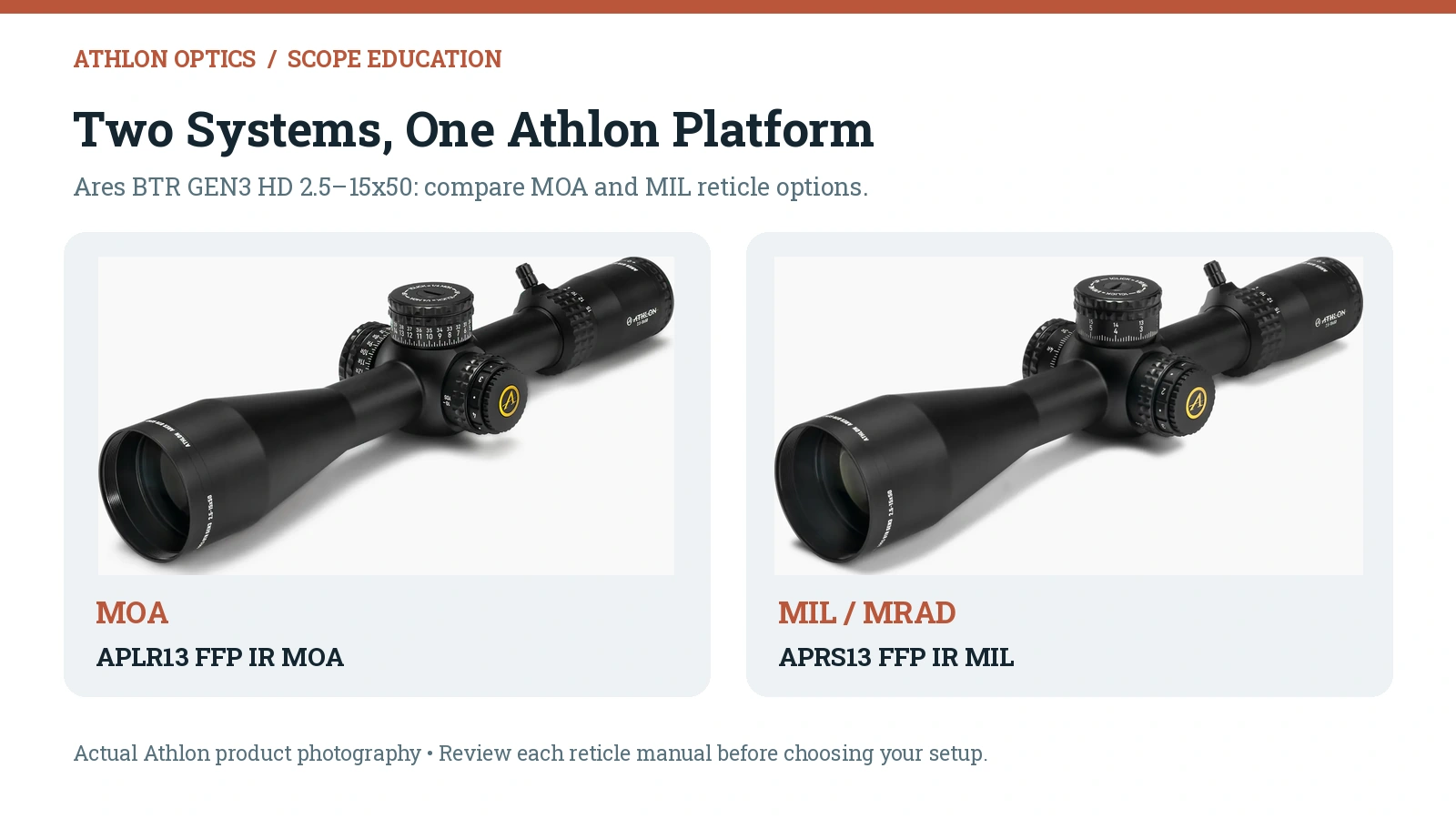
Our Ares BTR GEN3 HD lineup includes APLR13 FFP IR MOA and APRS13 FFP IR MIL reticle options. Compare the actual reticle layouts and manuals to decide which references fit the way you shoot.
Explore our rifle scopes, compare the Ares BTR GEN3 HD lineup, or use the Athlon Optics Scope Finder to narrow your options. Review the reticle manuals before choosing your setup.
Find an optic with the reticle, adjustment system, and features that fit your setup.